


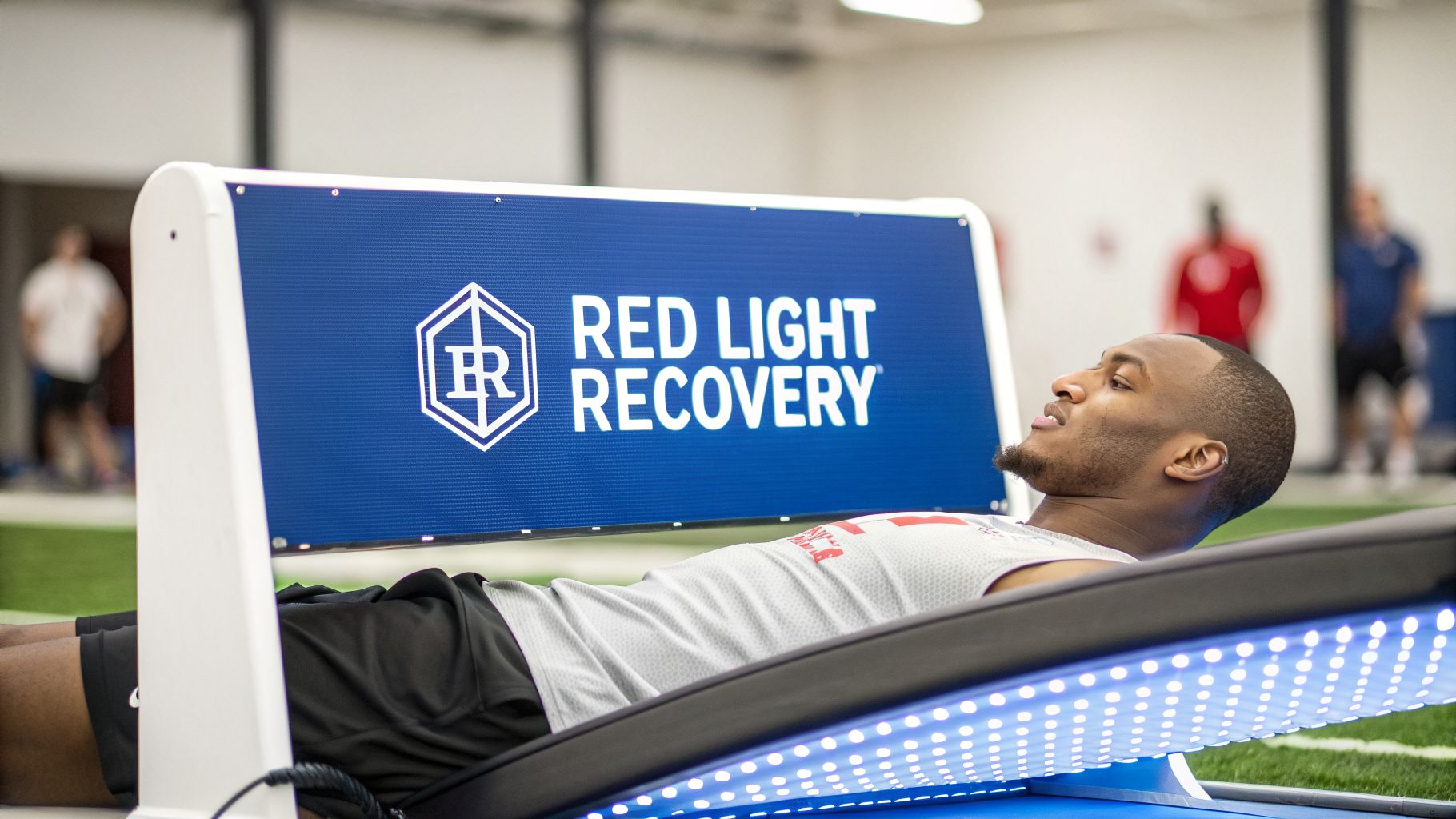
Red light therapy is a non-invasive way to help your body recover from physical stress. By delivering specific wavelengths of light directly to your tissues, it helps cut down on inflammation, ease muscle soreness, and accelerate the natural repair process after a tough workout. It has become a go-to tool for elite athletes and wellness clinics aiming to improve performance and bounce back faster.
How red light therapy speeds up recovery
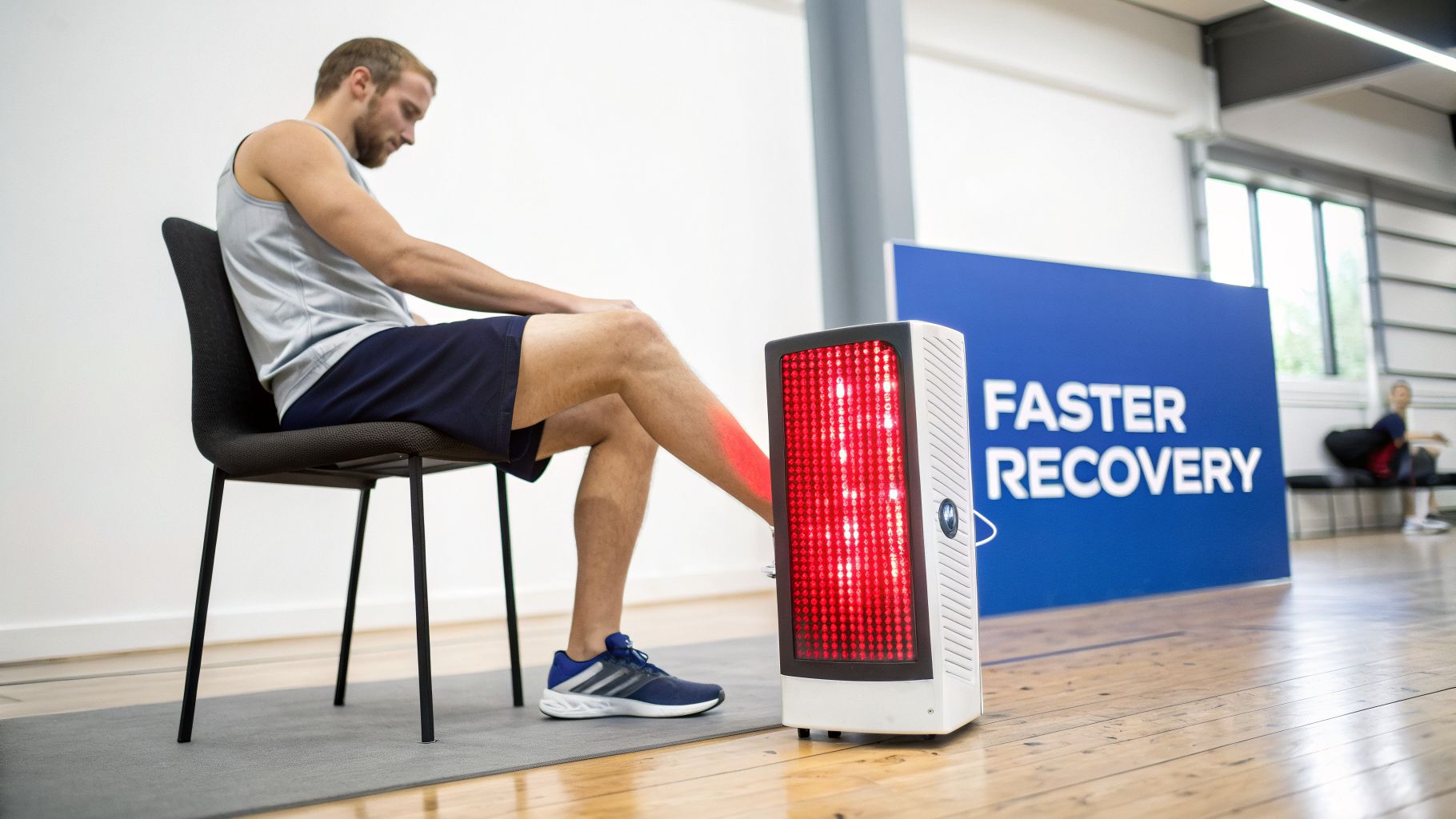
The science behind red light therapy, also known as photobiomodulation, is interesting. Think of it as a biological charging station for your cells. It uses specific, clinically-proven wavelengths of red and near-infrared (NIR) light that can penetrate through the skin to reach muscles and other deep tissues.
This isn’t a heat lamp. The process works when this light energy is absorbed by the mitochondria inside our cells—the tiny engines responsible for producing cellular fuel.
Boosting cellular energy
Every cell in your body runs on an energy-carrying molecule called adenosine triphosphate (ATP). After a hard workout, your cells have used up a ton of their ATP, leaving your muscles feeling fatigued and weak. Red light gives your mitochondria the specific signal they need to get back to work and produce more ATP.
When mitochondria absorb these photons of light, they kick into a higher gear. This surge in energy gives your cells the fuel they need to do their jobs more effectively, especially repair and regeneration. This is the fundamental mechanism behind red light therapy recovery.
With this increased cellular function, tissues can mend themselves more efficiently. Your body can clear out inflammatory byproducts, reduce swelling, and rebuild damaged muscle fibers much faster than it could on its own.
The explosive growth of this technology in sports medicine and performance centers speaks for itself. The market for red light therapy panels is on track to hit USD 1.7 billion by 2029, driven largely by its integration into athletic recovery protocols. According to Fortune Business Insights, consistent use can result in up to 40% faster muscle recovery after strenuous exercise. North America is leading this charge, with countless professional athletes now relying on it to minimize downtime. You can explore the full research about these findings for more detail on this trend.
From cellular action to real-world benefits
This boost in cellular energy isn't just something that happens on a microscopic level. It creates tangible, feel-it-in-your-body results. When your cells are working at their best, your body as a whole performs better and recovers quicker.
This accelerated repair process translates into several outcomes for anyone from a professional athlete to a weekend warrior:
- Faster Muscle Repair: By fueling the cellular repair cycle, red light helps muscle fibers rebuild more quickly after being broken down during exercise.
- Reduced Soreness: The therapy helps manage the inflammatory response that causes delayed onset muscle soreness (DOMS), so you feel less stiff and achy after a tough session.
- Improved Performance: Quicker recovery allows you to train more frequently and with greater intensity, leading to more consistent performance gains over time.
- Support for Connective Tissues: The benefits extend beyond muscle. The therapy also supports collagen synthesis, a building block for healthy tendons and ligaments.
This technology makes professional-grade recovery accessible. It’s a straightforward and powerful way to help your body handle the demands of intense physical activity. By working from the cell up, red light therapy offers a foundational tool for anyone serious about their performance and physical well-being.
The science behind cellular repair and reduced inflammation
To really get how red light therapy recovery works, we have to look at what's happening inside your body after a tough workout. Intense exercise creates tiny, microscopic tears in your muscle fibers. This damage naturally triggers an inflammatory response. It's your body’s first step toward healing, but it's also the source of that all-too-familiar muscle soreness and fatigue.
Red light therapy works by stepping in and influencing these biological processes to make them more efficient. It helps manage the unavoidable byproduct of hard work: oxidative stress. Strenuous activity generates unstable molecules called free radicals, which can damage your cells. Red light gives your cells the energy to produce more of their own antioxidants, which neutralize these free radicals and protect your tissues from extra harm.
This cellular shield is important for controlling the body's inflammatory response. A little inflammation is good and necessary for healing, but too much of it just leads to more pain and slower recovery.
Taming inflammation and easing muscle soreness
One of the most noticeable benefits of red light therapy is its ability to calm down inflammation. It helps regulate the body’s release of inflammatory markers, known as cytokines. By soothing this response, the therapy gets right to the root cause of delayed onset muscle soreness (DOMS)—that deep ache that sets in a day or two after you’ve pushed your limits.
When inflammation is kept in check, you simply feel less pain and stiffness. This makes for a much more comfortable recovery and lets you get back to your training schedule faster. Research backs this up, showing that therapy can significantly lower the enzymes linked to muscle damage and soreness, particularly when it's used soon after exercise.
By directly influencing the body's inflammatory pathways, red light therapy helps transition your muscles from a state of damage to a state of repair more quickly. This means less downtime and a more efficient recovery cycle.
Boosting circulation for faster rebuilding
Another major piece of the puzzle is improved blood flow. Red light therapy encourages vasodilation, which is the widening of your blood vessels. Think of it as opening up a superhighway for your body's internal repair crews to get to work.
This improved circulation is a double win for recovery:
- It delivers essential resources: More oxygen and nutrients are rushed directly to your tired muscles, giving them the raw materials they need to repair and rebuild.
- It clears out the waste: It efficiently flushes out metabolic byproducts, like lactic acid, that build up during exercise and contribute to fatigue and soreness.
This two-part process ensures your muscles get everything they need to heal while simultaneously clearing out the junk that’s slowing things down. The result is a cleaner, more efficient healing environment. You can learn more about these and other infrared light therapy benefits in our detailed article.
Rebuilding connective tissues with collagen
A complete recovery goes beyond just the muscles. Your connective tissues—tendons and ligaments—also take a beating during intense physical activity. Here, red light therapy provides support by stimulating the production of collagen.
Collagen is the primary structural protein that acts as the scaffolding for your skin, tendons, and ligaments. Red light therapy prompts the body’s fibroblast cells—the tiny factories that create collagen—to kick into a higher gear.
This is a big deal for both injury prevention and rehabilitation. Stronger, more resilient connective tissues are less likely to suffer from strains or tears. For an athlete working through an injury, this boost in collagen can speed up the healing process and help restore full function sooner, making red light therapy a truly comprehensive recovery tool.
Using red light therapy for peak athletic performance
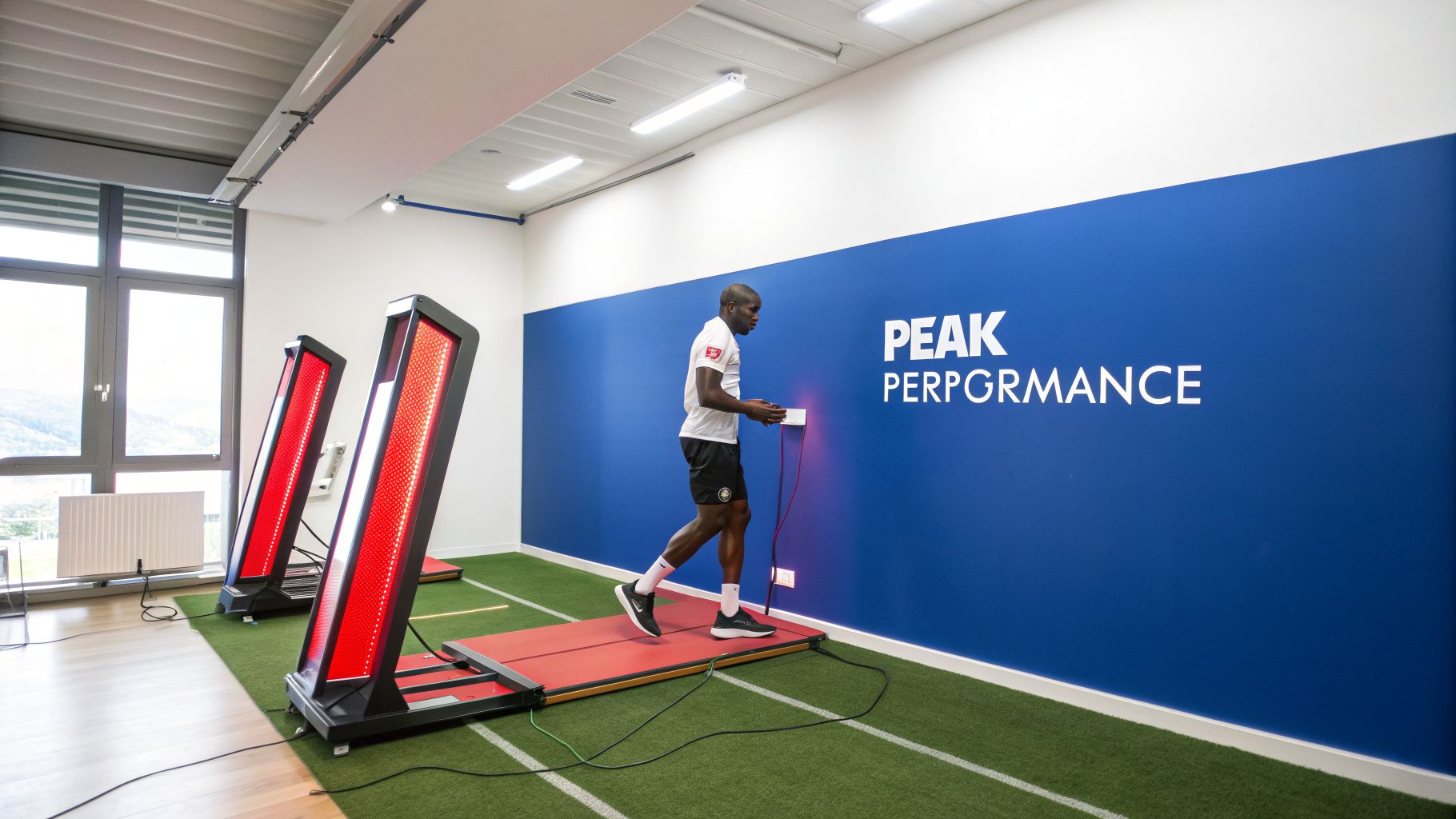
In elite sports, every fraction of a second and every ounce of energy counts. It’s no surprise that top organizations are constantly searching for a competitive edge, and many have found it in red light therapy recovery. For top-tier athletes, the cycle of training, competition, and rest is relentless. Any tool that makes that cycle more efficient is a necessity.
This is why red light therapy has transitioned from a niche treatment to a staple in professional training rooms. Its application is brilliantly simple yet powerful because it addresses both pre-activity preparation and post-activity repair. This dual strategy helps athletes perform with greater power during workouts and bounce back faster afterward, creating a virtuous cycle of high-level performance.
The therapy's rise isn't just anecdotal. According to Coherent Market Insights, the global market is on a trajectory to hit USD 8.21 billion in 2025. A January 2024 study from the Australian Institute of Sport found that 30% of its athletes already use it, crediting the tech for faster muscle repair. In North America, which commands a 32.3% market share, athletic programs are installing these systems to keep their players on the field and performing at their absolute best. You can see the data on the growing red light therapy market to understand just how widespread this adoption has become.
Priming muscles before a workout
Using red light therapy before a workout is a strategy called pre-conditioning. You can think of it as giving your muscles a warm-up at the cellular level. A short session of just 10-15 minutes is all it takes to prepare the body for the intense physical demands ahead.
This pre-workout light exposure works to:
- Boost blood flow: It triggers vasodilation, widening blood vessels to improve circulation to the muscle groups you’re about to tax. This means more oxygen and fuel are delivered right where they're needed, helping you work more efficiently from the very first rep.
- Delay muscle fatigue: By giving your cells a jump-start on ATP (energy) production, you begin your workout with a fuller tank. This can translate to better endurance and higher power output throughout the session.
- Buffer against exercise-induced damage: Some research indicates that pre-conditioning with red light helps shield muscle cells from some of the microscopic stress and damage that intense exercise causes.
This proactive approach means athletes can push harder and train longer before hitting that proverbial wall. It’s about setting the body up for success before the hard work even starts.
Accelerating repair after a workout
The most well-known application for red light therapy is post-exercise recovery. After a grueling workout or game, the body is in a state of controlled chaos—micro-tears in the muscles and a natural inflammatory response are in full swing. This is where a post-workout session becomes absolutely important for minimizing downtime.
Post-workout sessions directly augment the body’s own healing mechanisms. By helping to manage inflammation and supplying cells with the energy they need to repair, the therapy significantly reduces delayed onset muscle soreness (DOMS). An athlete who is less sore can get back to high-intensity training sooner, preserving their competitive edge.
For a sports organization, this translates into a tangible return on investment. Faster recovery means greater athlete availability. When your key players spend less time sidelined by soreness or minor strains, they spend more time training, competing, and winning.
This leads directly to a lower risk of non-contact injuries, which so often occur when an athlete is over-fatigued or not fully recovered. Facilities that provide advanced recovery tools like red light therapy are offering a clear advantage. They empower their athletes to stay healthy and perform at their peak, shifting the culture from reactive injury treatment to proactive health management.
Effective red light therapy recovery protocols
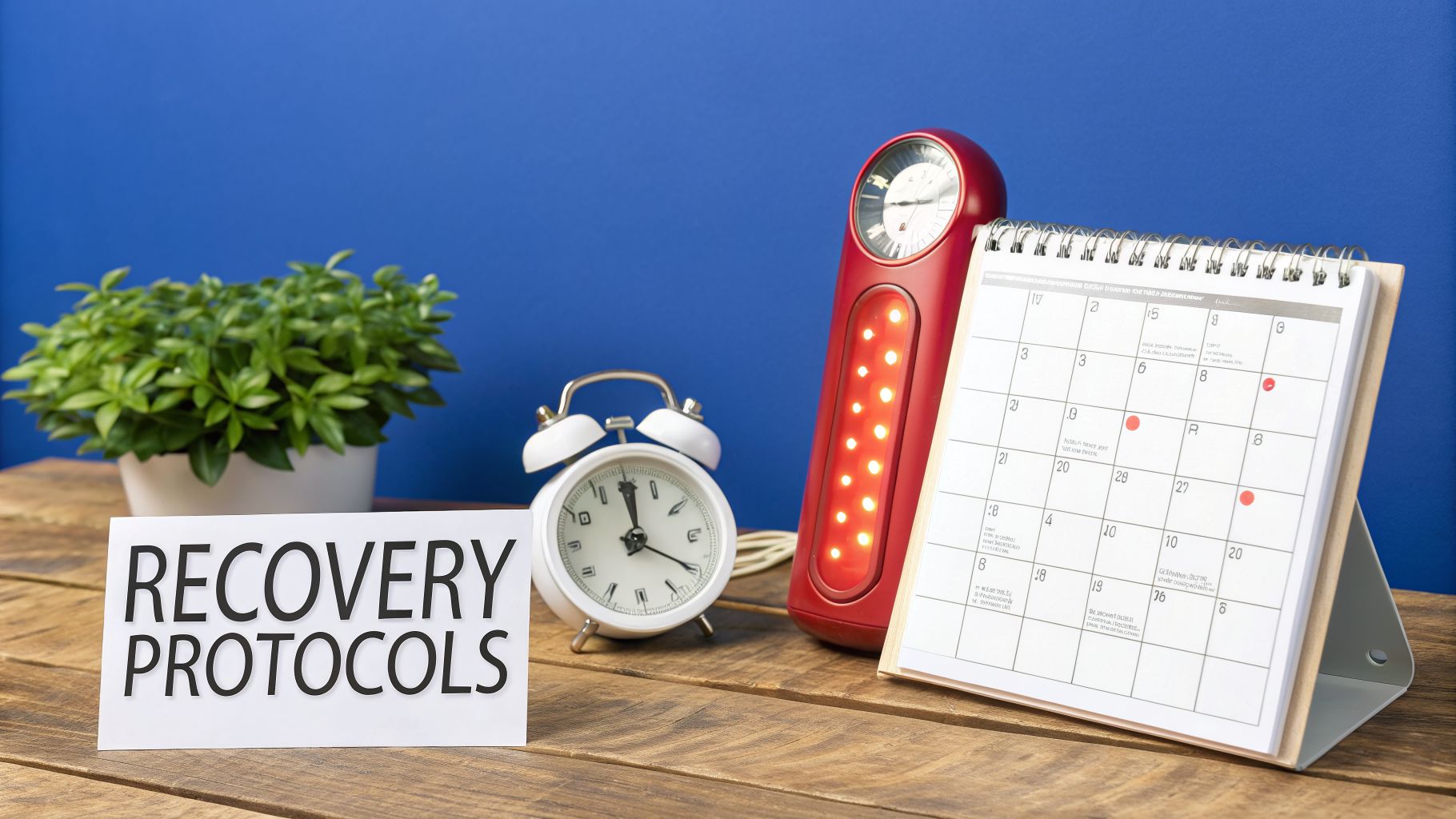
To unlock the benefits of red light therapy for recovery, you need a game plan. Dabbling with a few sessions here and there might feel good, but lasting results come from consistent and well-timed protocols. The secret is knowing how to deliver the right amount of light energy to the right tissues, at the right time.
The foundation of any effective protocol is dosage, which is the total amount of light energy delivered to a specific area. It’s measured in Joules per square centimeter (J/cm²)—a unit that combines both the light's power and the session's duration into one simple number.
Think of it like watering a plant. Give it too little water, and it wilts. Too much, and you drown the roots. In the same way, an optimal dose of light gives your cells precisely what they need to repair and regenerate, without being overwhelmed.
Understanding your target dosage
The ideal dosage all comes down to your recovery goals. Because different tissues absorb light differently, your protocol has to be adjusted based on what you’re trying to achieve.
- For surface tissues: When you’re dealing with issues closer to the skin, like minor scrapes or surface-level inflammation, a lower dose gets the job done. A range of 3-7 J/cm² is usually perfect.
- For deep muscle recovery: To get light deep into muscles and connective tissues after a tough workout, you need more power. A higher dose of 10-20 J/cm² is what’s needed to make sure enough energy penetrates to those deeper layers.
Thankfully, modern red light therapy systems make this incredibly simple. High-quality devices come with presets or clear guides that help you dial in the correct dosage for your goals, taking the complex calculations out of the equation and ensuring every session is effective.
Sample protocols for different users
A one-size-fits-all approach just doesn't cut it with red light therapy. An elite athlete’s needs are worlds away from someone focused on general wellness. Here are a couple of examples showing how protocols can be adapted.
Athlete's Post-Training Protocol:
An athlete who just smashed a heavy leg day needs to zero in on deep muscle repair and calming inflammation.
- Goal: Speed up muscle repair, reduce DOMS (Delayed Onset Muscle Soreness).
- Timing: Within 1-2 hours after the workout.
- Dosage: 15-20 J/cm² aimed at major muscle groups like quads, hamstrings, and glutes.
- Session Length: 15-20 minutes with a powerful, full-body system.
- Frequency: 4-5 times per week on heavy training days. You can learn more about targeted red light therapy for legs in our guide.
General Wellness User's Protocol:
For someone looking to manage everyday inflammation and boost their overall energy, the requirements look a little different.
- Goal: Lower systemic inflammation and increase cellular energy.
- Timing: Any time of day that works with their schedule.
- Dosage: 8-12 J/cm² for a full-body treatment.
- Session Length: 10-15 minutes.
- Frequency: 3-4 times per week to maintain consistent benefits.
Consistency is the most important factor in any red light therapy protocol. Just like exercise, the benefits build on each other over time. Weaving sessions into a regular weekly routine produces far better outcomes than just using it occasionally.
The market backs this up. The global value for light therapy is projected to hit USD 1.16 billion in 2025. North America is leading the charge with a 36% market share, as chiropractic and orthopedic centers are seeing 35% faster patient throughput thanks to accelerated tissue repair. This trend is mirrored in professional sports, where NFL and CrossFit athletes are cutting soreness by 25-40%. This data shows that consistent, protocol-driven use is creating powerful, real-world results.
Combining red light therapy with other recovery methods
Smart recovery isn’t about finding one magic tool; it's about building an intelligent system. While red light therapy is powerful on its own, you can amplify its benefits by thoughtfully stacking it with other modalities. When you combine therapies that work in harmony, you create a synergistic effect—the total benefit becomes greater than the sum of its parts.
Think of red light therapy as a foundational piece in a modern recovery protocol. The goal is to create a sequence where one therapy perfectly prepares the body for the next, making every step more effective. Each method targets a different piece of the recovery puzzle, from circulation to cellular energy, for a truly comprehensive approach.
Intermittent vacuum and light therapy
One of the most effective pairings we see is the combination of red light therapy with intermittent vacuum therapy. This isn't just a random mix-and-match; it's a duo that works in a logical, powerful sequence to magnify results. The intermittent vacuum, like the technology found in the Vacustyler, is the ideal setup for a red light session.
Here’s a look at how they work in concert:
- Vacuum Prepares: The intermittent vacuum applies and releases gentle negative pressure around the lower body. This action triggers passive vasodilation, opening up blood vessels and boosting circulation without you having to lift a finger.
- Light Penetrates: Immediately after the vacuum session, your body is perfectly primed. With blood flow already optimized, the red and near-infrared light can penetrate deeper into the tissues, reaching the cells that need it most with far greater efficiency.
- Waste Is Cleared: The improved circulation from the vacuum also means your body can more effectively flush out the metabolic waste that red light therapy helps release from the cells. It's a one-two punch that first opens the pathways and then clears the system.
This combination creates the ideal environment for red light therapy recovery. It ensures the light energy is put to work for cellular repair and inflammation reduction as effectively as possible.
Other complementary pairings
Beyond vacuum therapy, red light can be intelligently stacked with several other popular recovery tools. The secret is knowing how to sequence them to your advantage. Finding the right order can dramatically improve your outcomes. You can learn more about how different modalities work together by exploring some of the best recovery tools for athletes.
Consider these strategic pairings:
- Red Light Therapy Before Cryotherapy: Using red light before a cryo session helps pre-condition the muscles. The light boosts cellular energy and circulation, preparing the tissue for the intense cold, which then delivers its own powerful anti-inflammatory effect.
- Red Light Therapy After IV Therapy: Following an IV drip with a red light session can help your body make the most of those infused nutrients. The boost in cellular energy from the light helps cells absorb and use the vitamins and minerals more efficiently, supporting wellness from the inside out.
- Red Light Therapy With Compression Therapy: Using red light first can help reduce inflammation at the cellular level. This prepares the tissues for the mechanical flushing effect of compression boots, which then help move out excess fluid and metabolic byproducts.
By thoughtfully combining these modalities, you create a recovery protocol that is both deep-acting and comprehensive. This stacking method offers a significant return on investment for both users seeking faster results and facility owners aiming to provide premium, effective services.
Is red light therapy a safe recovery tool?
Whenever you're looking at adding a new tool to your recovery arsenal, the first question is always the same: “Is it safe?” It’s a fair question, and when it comes to red light therapy recovery, the answer is overwhelmingly positive.
One of the main reasons this therapy has become so trusted in clinics and sports facilities is its outstanding safety profile. It’s completely non-invasive, using specific wavelengths of light that go to work on a cellular level without burning or harming the skin’s surface.
The light is non-ionizing, which means it doesn’t carry the risks you’d find with damaging UV light from the sun or tanning beds. Instead of causing harm, these calibrated red and near-infrared wavelengths give your cells a gentle energy boost, helping them do their jobs better and supporting your body's own natural healing mechanisms.
Following common-sense precautions
While red light therapy is considered very safe, using it responsibly is the key to getting great results without any hiccups. The most important step is always to follow the manufacturer’s instructions for your specific device. This makes sure you’re using the right session times and distances for an effective treatment.
A few straightforward precautions will ensure a safe and comfortable experience:
- Eye Protection: When using powerful light panels that face you directly, it's good practice to wear the provided blackout goggles. While the light itself isn't inherently damaging, its brightness can be intense and uncomfortable for your eyes.
- Follow Guidelines: Stick to the recommended session times. The goal is to give your cells an optimal dose of light energy; more isn't necessarily better, and excessively long sessions are not recommended.
- Device Quality: Always choose devices from reputable manufacturers that are transparent about their specifications, especially their light output or irradiance.
Who should be cautious
For the vast majority of people, red light therapy is a safe and highly beneficial tool. However, certain conditions do call for a bit of caution. It’s always a good idea to chat with your doctor before starting any new therapy, especially if you have pre-existing health concerns.
The general consensus is that red light therapy is a low-risk modality. As one sports medicine physician from University Hospitals, Dr. Jacob Calcei, noted, “The data that we have currently on red light therapy shows that it’s low risk, so it’s fairly safe.”
Individuals in the following groups should speak with their healthcare provider before using red light therapy:
- Pregnancy: There simply isn't enough research on how red light therapy might affect a developing fetus, so it’s generally advised to avoid use during pregnancy.
- Active Cancer: Anyone undergoing treatment for active cancer should avoid using red light therapy directly over tumor sites, as its effects on cancer cells aren't fully understood.
- Photosensitivity: If you have a condition that makes you sensitive to light, or if you are taking medications that increase photosensitivity, red light therapy might not be a good fit for you.
By being transparent about these considerations, you can make an informed decision and integrate this effective recovery tool into your routine responsibly and safely.
Common questions about red light therapy recovery
Even as red light therapy becomes a staple in recovery protocols, it’s natural to have questions before you try it. We get it. New technology always comes with a learning curve.
To help you feel confident, we’ve put together some straightforward answers to the most common questions we hear from clients and athletes.
How long does it take to see results?
This is always the first question, and the answer depends on your goals. Some of the benefits are immediate. The moment the session starts, you'll feel a gentle, pleasant warmth. Many people report a noticeable drop in muscle soreness and stiffness after just one session, especially when they use it right after a tough workout.
For the deeper, structural benefits—like accelerated tissue repair or measurable gains in performance—consistency is everything. You can expect to see real improvements in your workout capacity and a reduction in nagging injuries after several weeks of regular use. The key is to stick with the program.
Does red light therapy feel hot or painful?
Not at all. A red light therapy session should never feel hot or be painful. It uses specific, non-thermal wavelengths of light to communicate with your cells. This is completely different from an infrared sauna, which is designed to generate heat.
Most people just describe the sensation as a soothing, gentle warmth on their skin. It’s a very relaxing experience. If you ever feel anything more than that, the device is likely too close or the session is running too long.
What is the difference between at-home and professional systems?
This is a great question. The main differences boil down to power, coverage, and the efficiency of your session.
-
Power (Irradiance): Professional systems, like the ones you’ll find in clinics and athletic training centers, have a much higher power output. This means they can deliver a therapeutic dose of light in a much shorter time, making every session more effective. A 10-15 minute session in a professional-grade unit can deliver more benefits than a much longer session with a small, low-powered home device.
-
Coverage Area: Professional systems like full-body beds or large panels can treat your entire body at once. This is a game-changer for tackling systemic inflammation and achieving comprehensive athletic recovery. Most at-home devices are small and really only designed for spot-treating one specific area, like a sore knee or shoulder.
While at-home devices are great for targeted spot treatments, professional systems are built for full-body recovery and efficiency. They provide a more powerful and comprehensive session that is better suited for serious athletes or anyone looking for maximum results in minimum time.
This is precisely why so many people choose to visit facilities with professional-grade equipment for their red light therapy recovery needs—you get a better result in less time.
Ready to experience a more advanced and efficient approach to recovery? Weyergans HighCare US offers the Vacustyler, which combines intermittent vacuum therapy with integrated red light to optimize circulation and accelerate your body's natural healing processes. Discover how our German-engineered system can elevate your recovery at https://weyerganshighcareus.com.