


A picosecond is a nearly imperceptible slice of time—just one trillionth of a second, written out as 10⁻¹² seconds. Our lives unfold in seconds, minutes, and hours, but advanced physics, chemistry, and high-speed electronics operate on a clock that is almost impossibly fast. This is the scale of the picosecond.
Putting a picosecond into perspective
Trying to grasp a trillionth of a second is difficult. To bring this abstract concept down to a more human scale, picture a full-sized football field.

If one second is the time it takes to walk the entire 100-yard length of that field, from one end zone to the other, then a single picosecond would be smaller than a single grain of sand under your feet. It's a timescale where molecular bonds are just beginning to vibrate and where light itself seems to crawl.
It’s a measurement that is 1,000 times shorter than a nanosecond (a billionth of a second), which is already extremely fast. This extreme speed is what allows technologies like ultrafast lasers and modern telecommunications to perform tasks with incredible precision.
To see how these timescales stack up against each other, it helps to put them side-by-side.
Understanding time scales at a glance
This table compares familiar units of time, from a second down to a picosecond, to show their relative scale.
| Unit | Scientific Notation | Fraction of a Second | Relatable Comparison |
|---|---|---|---|
| Second | 10⁰ s | 1 second | A quick count, “one-one-thousand” |
| Millisecond | 10⁻³ s | 1/1,000th | The flash of a standard camera |
| Microsecond | 10⁻⁶ s | 1/1,000,000th | A high-speed camera shutter |
| Nanosecond | 10⁻⁹ s | 1/1,000,000,000th | Time for light to travel about 1 foot |
| Picosecond | 10⁻¹² s | 1/1,000,000,000,000th | Time for light to travel the thickness of paper |
As you can see, each step down is a thousand times faster than the one before it, taking us into a world where the fundamental processes of nature unfold.
How fast is a picosecond in the real world?
To get a feel for a picosecond, we need to anchor it to something real. The best ruler we have for this is the speed of light, the ultimate speed limit of the universe.
In one picosecond, a beam of light travels just 0.3 millimeters. That’s roughly the thickness of a single sheet of office paper. It’s a distance you can feel between your fingers.

This incredibly short distance makes the picosecond so mind-boggling. While a nanosecond already seems impossibly fast, light travels a full foot in that time. The difference between the two is immense and shows just how granularly time can be measured.
Scaling up the speed of light
Seeing how quickly these tiny distances multiply as we move up the timescale shows the speed of events at this level.
- In one picosecond: Light travels 0.3 millimeters—the thickness of that sheet of paper.
- In one nanosecond (1,000 picoseconds): Light zips across 30 centimeters (about 1 foot), the length of a standard ruler.
- In one microsecond (1,000 nanoseconds): Light covers 300 meters, more than the length of three football fields.
- In one full second: Light travels an astonishing 300,000 kilometers (186,000 miles), far enough to circle the Earth more than seven times.
This physical limit is why picosecond-level control is so important in fields where things happen at nearly the speed of light, like in advanced microchips and laser systems. The ability to manage processes on this timescale unlocks operations that would be physically impossible with slower technology.
Picosecond lasers in modern medicine
This precise control has a direct and powerful impact on modern medicine and aesthetic treatments. The global picosecond laser market is on track to surpass $500 million by 2026, driven by its success in non-invasive procedures.
These advanced lasers deliver energy in such short pulses that they can shatter tattoo pigments under the skin without burning the surrounding tissue. This is a huge leap forward from older nanosecond lasers, which caused up to 30% more thermal damage.
The results speak for themselves. Clinics report 90% patient satisfaction rates, and tattoo removal often requires just 4-6 sessions instead of the 10-15 needed previously. You can explore more about how this tiny unit of time is changing treatment protocols on Wikipedia's page for the picosecond.
Where picoseconds power modern technology
A picosecond might sound like something confined to a physics lab, but this tiny sliver of time is the engine behind some of our most impressive modern technologies. From precise medical treatments to the computer you're using right now, understanding where picoseconds are at play shows why this level of precision is practical.
Medical and aesthetic lasers
One of the most widely known applications for picosecond technology is in advanced lasers for medicine and aesthetics. You’ve likely heard of picosecond lasers for things like tattoo removal or skin resurfacing, and there’s a good reason they’re so effective.
Instead of burning a target with heat, a picosecond laser delivers energy so quickly that it creates a shockwave effect. This shatters tattoo ink particles or vaporizes pigmented skin cells without heating and damaging the surrounding healthy tissue.
This photomechanical process is a significant improvement. It's far more precise than older nanosecond lasers, which means better results with much less collateral damage and fewer side effects. It’s this same focus on precision light energy that informs the benefits of infrared light therapy for skin health.
The aesthetics industry is investing heavily in this technology. By 2026, picosecond lasers are on track to capture 55% of the $4.2 billion global tattoo removal market, mainly because they can cut down on skin damage by 80%.
Ultrafast science and spectroscopy
For scientists, picosecond pulses are like the ultimate high-speed camera flash, letting them witness events that happen far too quickly for any normal camera to see. This field is called ultrafast spectroscopy.
Imagine trying to film a chemical reaction as it happens. Researchers can do just that by using a "pump-probe" technique. They kickstart a reaction with one laser pulse (the "pump"), then take a snapshot with a second, slightly delayed pulse (the "probe"). By repeating this and varying the delay, they can assemble a stop-motion movie of molecules moving and bonds breaking or forming in real-time.
This tool is used across many disciplines:
- Chemistry: To see the very first moments of a chemical reaction.
- Biology: To watch how a protein folds itself into the right shape.
- Materials Science: To analyze how electrons move in new types of semiconductors.
- Physics: To observe the behavior of matter under extreme conditions.
High-speed electronics and computing
The raw speed of every modern electronic device is built on events that happen at the picosecond level. Every time your computer’s processor performs an operation, millions of tiny transistor switches are flipping on and off at an unbelievable pace.
A standard 3.0-gigahertz CPU, for instance, completes one of its basic clock cycles in about 330 picoseconds. This speed is what allows your phone or laptop to stream video, run complex software, and process massive amounts of data without skipping a beat. As technology keeps pushing forward, these switching times are only getting shorter, which means more powerful electronics in everything from our gadgets to massive data centers.
Connecting cosmic events to human health
The picosecond is a timescale that connects the dawn of the universe to the cells in our body. This brief moment is woven into the fabric of reality, and understanding it reveals how fundamental physics directly influences our health.
To find its first appearance, we have to travel back to the first moments after the Big Bang. This was when the laws governing our world began to solidify.
Around 10 picoseconds after the Big Bang, electromagnetism separated from the other fundamental forces. This event established the rules for everything from starlight to the energy transfers happening inside our cells.
This same timescale appears throughout the natural world. Some subatomic particles blink into existence for only about 1 picosecond. It takes a pulse of light just 3.3 picoseconds to cross a single millimeter. This direct link between time, distance, and energy is what makes the picosecond a powerful unit of measurement. You can explore the full definition of a picosecond on Dictionary.com for more detail.
From physics to cellular health
This understanding of ultrafast processes is not just theoretical. It has led to practical applications that work with our bodies on a cellular level. The effectiveness of many modern light-based therapies hinges on controlling energy delivery over these exact, ultra-short durations.
Technologies like picosecond lasers use these short pulses to deliver energy with surgical precision, targeting specific molecules or cells without damaging the surrounding tissue. This ability to influence cellular repair and regeneration is a major advance.
The power to control light on such a microscopic scale is also a key factor in other wellness applications. You can learn more about how different forms of light interact with our bodies by reading our article on the effects of blue light on skin.
It's a fascinating journey, showing how a concept born from cosmic physics has found a practical home in promoting human health—turning a fraction of a second into a powerful tool for recovery.
How scientists actually measure picoseconds
How do you time an event that’s over long before your brain can process that it started? You can't use a stopwatch. Measuring a picosecond requires ingenious scientific instruments that can translate these impossibly short flashes of time into something we can observe.
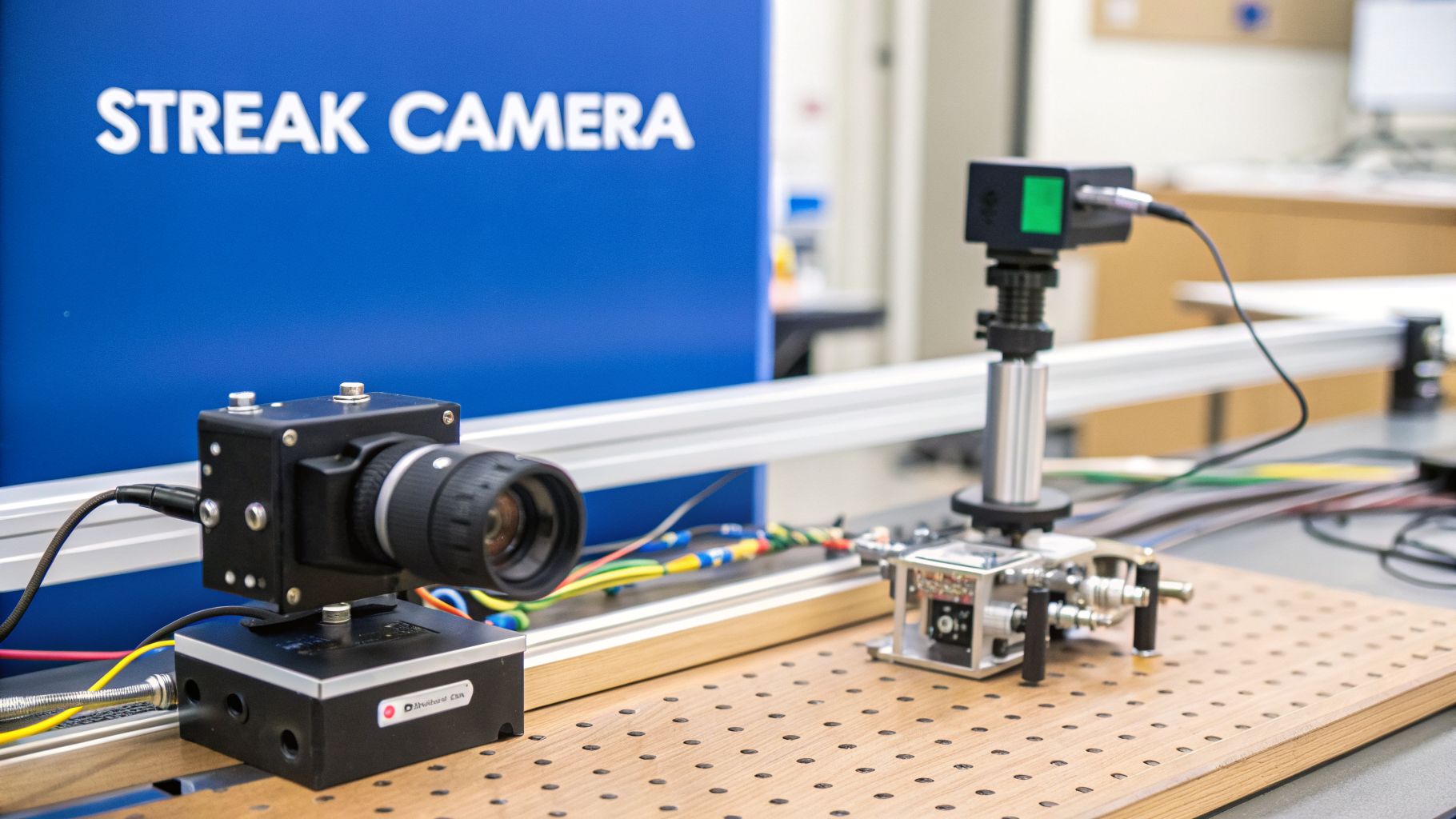
One of the most important tools for this job is the streak camera. Think of it as a specialized video camera built to capture fleeting pulses of light. It works by converting an incoming light pulse into a beam of electrons, then using a rapidly changing electric field to "streak" that electron beam across a detector screen.
The result is that the duration of the light pulse is directly translated into the length of the streak on the screen. Shorter pulses create shorter streaks, giving scientists a visual, measurable representation of an event that lasted mere trillionths of a second.
Pump-probe spectroscopy
Another powerful method is pump-probe spectroscopy. This technique is like creating a super-fast, stop-motion movie of molecular action. It’s a two-step process that allows us to "see" the unseeable.
- The "Pump" Pulse: First, a powerful, ultra-short laser pulse—the "pump"—hits a material. This initial burst of energy starts a physical or chemical event, like causing a molecule to start vibrating or an electron to jump to a new energy state.
- The "Probe" Pulse: A second, much weaker laser pulse—the "probe"—is sent in right after the first. It follows after a precisely controlled, tiny delay that can be just a few picoseconds. This probe pulse takes a "snapshot" of the system, measuring its state at that exact instant.
Scientists then run the experiment over and over, each time slightly increasing the time delay between the pump and the probe. This builds a sequence of snapshots, each one capturing the event a few picoseconds later than the last.
When pieced together, these individual snapshots create a slow-motion movie of what is happening on a picosecond timescale. This allows researchers to watch chemical reactions unfold or observe how energy moves through a material, one trillionth of a second at a time.
Common questions about the picosecond
To wrap our heads around this fast timescale, let's tackle some common questions. Understanding these concepts is key to seeing why the picosecond is a big deal in modern science and technology.
What is the difference between a picosecond and a nanosecond?
A nanosecond is one billionth of a second, but a picosecond is one trillionth of a second. This makes a nanosecond 1,000 times longer than a picosecond.
While both are extremely fast, that thousand-fold difference is huge in fields like laser surgery and high-speed electronics. Picosecond pulses deliver energy with far more precision, causing much less heat damage than their slower nanosecond counterparts.
Are there time units even smaller than a picosecond?
Yes. The next major leap down the timescale is the femtosecond, which is one quadrillionth of a second (10⁻¹⁵ s).
A single picosecond is made up of 1,000 femtoseconds. Scientists use femtoseconds to watch even faster events unfold, like the movement of electrons within individual atoms. It doesn't stop there—attoseconds are used to probe processes happening inside the atom itself.
Why are picosecond lasers better for things like tattoo removal?
Picosecond lasers are the standard for tattoo removal because their energy pulses are unbelievably short. They deliver energy so rapidly that they create a photomechanical effect—a tiny shockwave that shatters ink particles, rather than just heating them up. This is a significant improvement for minimizing damage to the surrounding skin.
Older nanosecond lasers use longer pulses that generate much more heat. This can lead to more pain, a higher risk of scarring, and a longer recovery period. The precision of picosecond lasers means the ink clears faster, fewer sessions are needed, and the entire experience is safer for the client. This focus on precision is also a key principle in therapies aimed at skin health and healing. You can learn more about how different light-based approaches can aid in red light therapy recovery in our related guide.