


The Spine Stretch is a classic Pilates mat exercise, but its name is almost an understatement. It’s not just a simple stretch—it's a fundamental movement designed to articulate the spine, lengthen the hamstrings, and fire up your deep core muscles. The goal is to sit tall and then peel your spine forward, vertebra by vertebra, creating a deep "C-curve" that decompresses the back and builds flexibility.
Why the spine stretch is a modern back health essential
This movement is so much more than a hamstring stretch. The Spine Stretch is a core pillar of the Pilates method, first created by Joseph Pilates in the 1920s as part of his "Contrology" system. He saw it as an antidote to the poor posture and spinal compression he witnessed all around him. A century later, its relevance has exploded, offering a direct counter-movement to the stiffness caused by our modern, sedentary lives.
This deliberate forward fold, performed with a rounded spine, is a masterclass in efficiency. It forces you to scoop your abdominal muscles inward and upward, which is key to strengthening your deep core. At the same time, it methodically creates space between each vertebra, relieving pressure along the entire length of your back.
A modern tool for wellness and recovery
For today’s desk-bound professionals and dedicated athletes, the Spine Stretch is a necessary tool for daily maintenance. It sharpens body awareness, boosts circulation to your back muscles, and melts away the physical stress that builds up from sitting for hours or from intense training. This is why it’s become a staple in high-end fitness, wellness, and athletic recovery protocols.
The soaring popularity of this exercise is part of a bigger picture. The global Pilates and yoga market hit USD 176.35 billion in 2024 and is on track to reach USD 420.98 billion by 2032. This is not just a trend; it's a movement of people seeking low-impact, effective ways to reclaim their health and mobility. You can see a full breakdown of the Pilates market’s growth in this report from Future Data Stats.
The beauty of the Spine Stretch is in its dual function. It powerfully strengthens the front of your body (the core) while simultaneously lengthening the back of your body (the spine and hamstrings).
This makes it an incredibly efficient way to hit multiple fitness goals with a single, mindful exercise. For medspas and wellness centers, offering movements like the Spine Stretch empowers clients to take an active role in their own posture correction and recovery, complementing other passive therapies. You can read more about how active exercises contribute to overall mobility and wellness here.
How to perform the spine stretch correctly
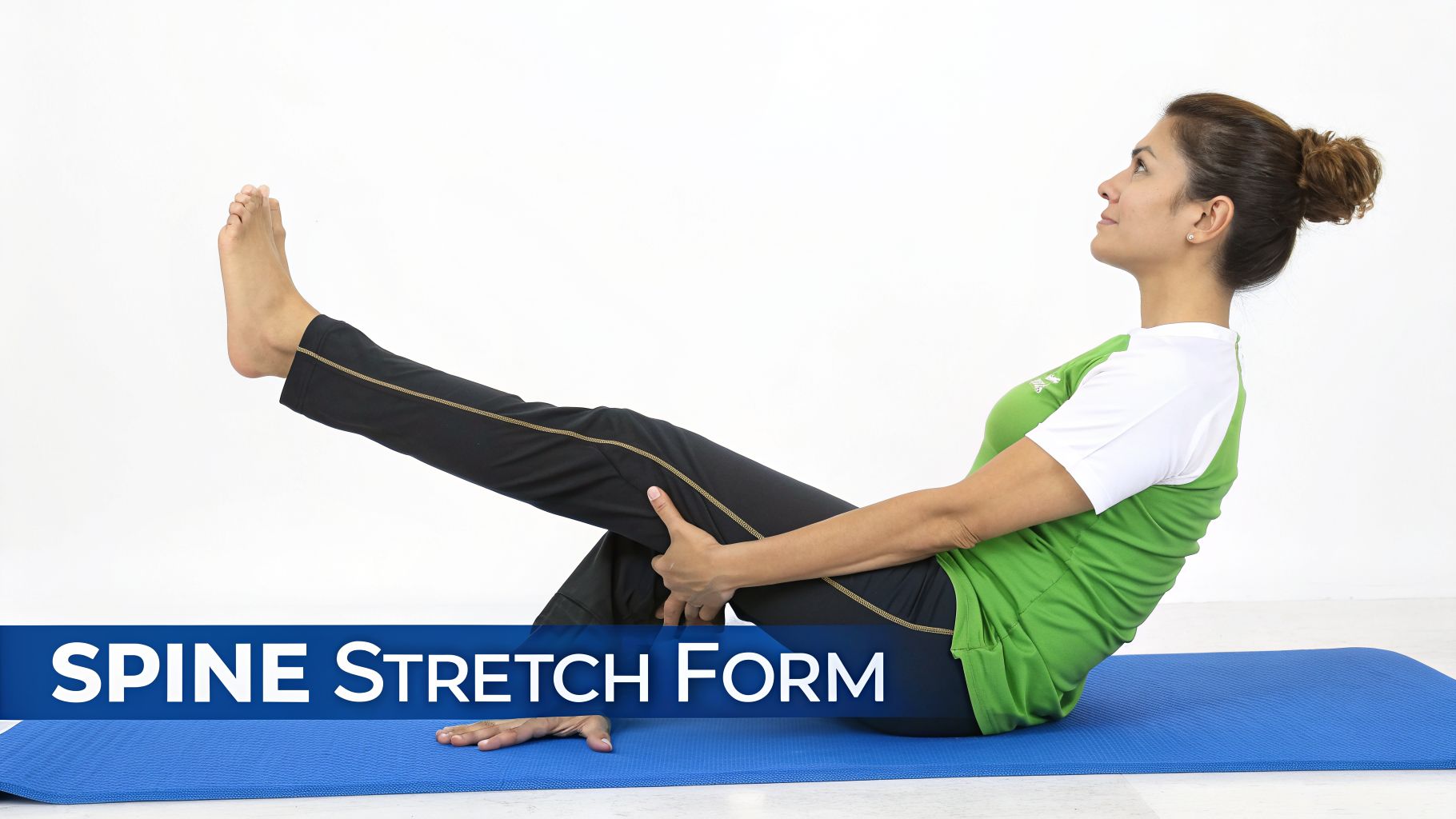
Mastering the spine stretch is all about control, not speed. Forget about how far you can reach. The real magic happens when you articulate your spine, creating a deep C-curve that decompresses each vertebra while firing up your core.
Let’s walk through the movement, piece by piece, so you can feel the difference between simply bending over and truly performing a spine stretch.
The initial setup
Every great movement begins with a solid foundation. Your setup makes the stretch both safe and effective, so take a moment to get it right.
Start by sitting tall on your mat. Imagine you’re trying to press your spine, block by block, flat against a wall behind you.
- Legs: Extend your legs out in front of you, opened to about the width of your shoulders. If your hamstrings are tight, don't force it—a soft bend in the knees is perfectly fine.
- Feet: Flex your feet. Pull your toes back towards your body as if you’re trying to stand on the wall in front of you. This small action, called dorsiflexion, engages the entire back line of your legs.
- Arms: Reach your arms straight forward at shoulder height, parallel to the floor. Now, consciously drop your shoulders down and away from your ears. No shrugging.
Before you move an inch, take a deep inhale. Use that breath to grow even taller, feeling the top of your head reaching for the sky.
The forward roll
This is where the real work begins. As you exhale, let your chin drop to your chest. Think of it as peeling your spine off that imaginary wall, starting with the very top vertebra and slowly working your way down.
The focus here is hollowing out your belly. This is not a passive collapse. You need to actively pull your navel in towards your spine to create space and support your back as you curve forward.
The C-curve is the entire point of the exercise. You're aiming to create a "cave" with your torso, making the front of your body concave and your back convex. This is what delivers that incredible feeling of spinal decompression.
Make sure to keep your sit bones glued to the mat. If you feel yourself rocking forward onto them, you've lost the spinal articulation and are just hinging from the hips.
Reaching the deepest point
Continue to exhale and roll forward, reaching the deepest point of your stretch. It doesn’t matter if your hands reach your ankles, your feet, or just hover in space. All are correct. The goal is to maintain the integrity of that deep C-curve, not to touch your toes.
At your deepest point, you should feel a lengthening all along your back and a nice, deep stretch in your hamstrings. Keep reaching through your heels and fingertips to create opposition and find even more length.
The return journey
To come back up, start with an inhale. The return is just as important as the roll-down. You’re going to rebuild your posture from the ground up.
Imagine you're stacking your spine back up against that imaginary wall, starting from the very bottom.
- Begin by rolling up through your lower back (lumbar spine).
- Continue stacking through your mid-back (thoracic spine).
- Finally, lift your upper back, neck, and head until you are sitting perfectly tall again.
Moving with intention on the way up builds core strength and reinforces proper spinal alignment. Once you’re back in that tall, seated position, you’re ready for your next repetition.
The real benefits of a regular spine stretch practice
Don't let the simple name fool you. While the Spine Stretch is fantastic for flexibility, its real power lies much deeper. This is a foundational Pilates movement that builds functional strength and body awareness, with benefits that ripple into every part of your daily life—whether you’re closing a deal in the boardroom or an athlete pushing for a new personal best.
At its core, the exercise is all about spinal articulation. You’re learning to move your spine one vertebra at a time, reawakening mobility in segments that often get stiff from daily life. This careful movement helps to decompress your spinal discs, creating space and relieving the constant pressure from gravity and hours of sitting.
A longer, leaner look and feel
That deep "scooping" action you perform with your abdominals is not just to protect your back. It’s an intense workout for your transversus abdominis, which is your body's natural corset. When this muscle is strong, it cinches everything inward, giving you a flatter-looking stomach and creating the illusion of a longer, leaner torso.
Excellent posture is another welcome outcome. By consistently practicing this controlled forward fold and the stacking of your spine, you sharpen your postural awareness. You'll start to notice how you sit and stand, making it easier to hold a healthier alignment all day long.
This is not just about feeling better; it's about measurable results. The Pilates and yoga market was valued at $127.7 billion in 2020 and is on track to double by 2028, largely because of the therapeutic value of exercises like this one. In fact, one study showed that routines incorporating the spine stretch can boost lumbar flexibility by 25% and slash lower back pain in 72% of participants. You can see more on the industry's growth in this Pilates and Yoga Studios Market Report.
Targeted relief for your lifestyle
The great thing about the Spine Stretch is how its benefits adapt to your specific daily demands. Here’s a look at what it can do for you:
- For the Desk-Bound Professional: Think of it as hitting the reset button on your spine. It offers immediate relief from the compressive force of sitting, undoing the damage of hours spent hunched over a laptop.
- For the Athlete: Better spinal mobility and a stronger core translate directly to improved performance and a lower risk of back injuries. It helps build a torso that's both more resilient and more responsive.
- For the Wellness Client: The deep breathing and focused movement boost circulation, nourishing the tissues all around your spine. This is a huge part of what creates that feeling of lightness you get after a great session.
When you integrate the Spine Stretch into your routine, you're not just stretching. You're re-educating your body, building the kind of deep core strength and spinal mobility that are essential for long-term back health.
If you're interested in going deeper, you can explore our related articles on Pilates for flexibility. This one exercise truly is a powerhouse for maintaining a healthy, functional body for years to come.
Common spine stretch mistakes and how to fix them
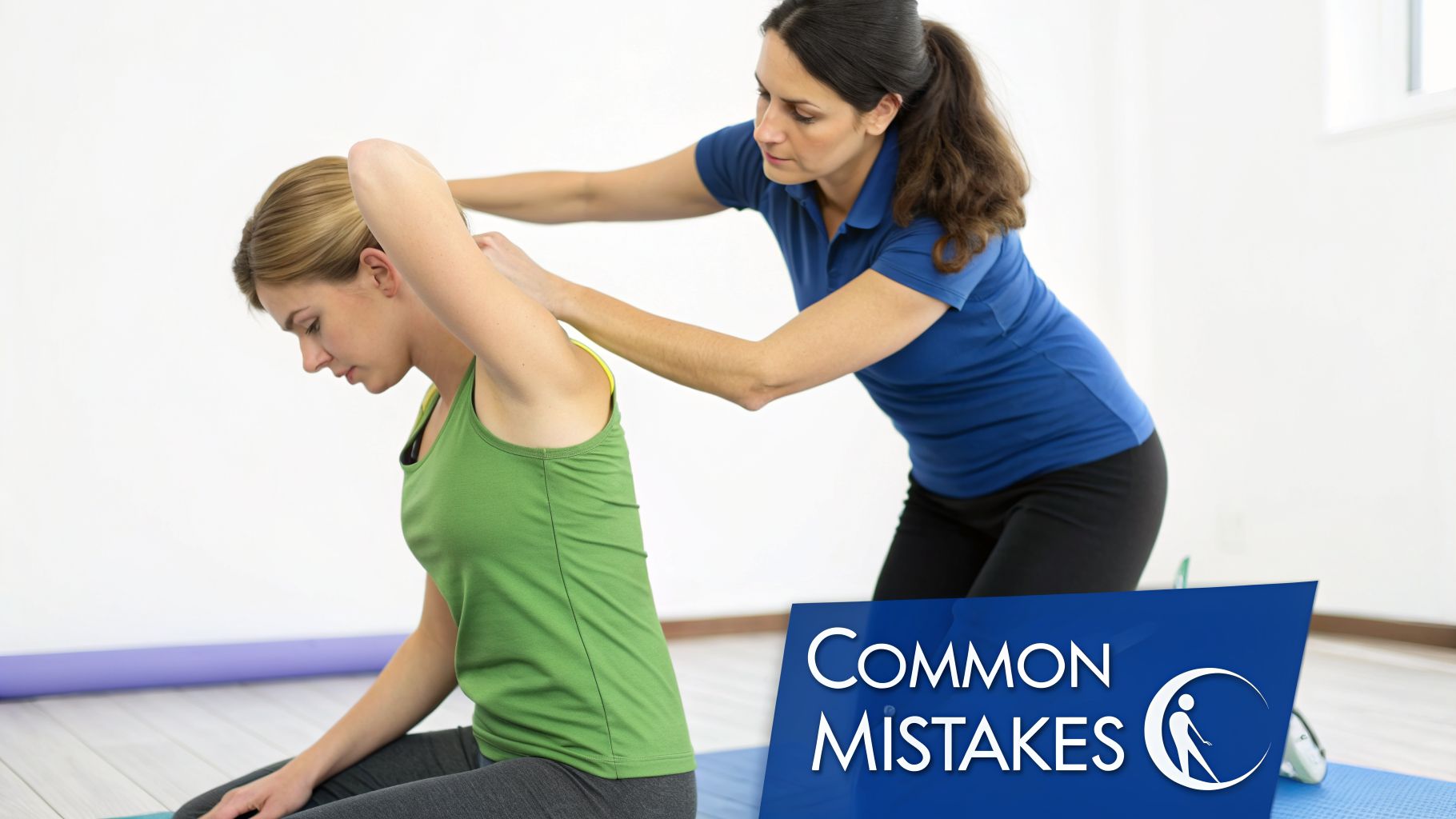
The spine stretch looks simple enough, right? Just sit up tall and fold forward. But in my experience, this is where tiny misalignments can rob you of the exercise's true power and even create unnecessary strain. Think of this as your personal troubleshooting guide.
Most mistakes happen when we forget this is an articulation exercise, not just a passive hamstring stretch. It’s all about creating a perfect C-curve, but we often end up collapsing the chest, hiking the shoulders, or forgetting the core altogether.
Forgetting the core scoop
This is the most common error I see. Instead of articulating the spine, people simply fold at the hips, keeping their back flat. This turns a powerful core and spine exercise into a basic hamstring stretch, missing the entire point of spinal decompression.
The fix is to initiate every single movement from your center. Before you even think about moving forward, focus on pulling your navel deep into your spine. This is the classic Pilates "scoop," the action that carves out your C-curve, protects your lower back, and allows you to peel down one vertebra at a time.
Your back should look like the outside of a parenthesis
). This shape, called a convex curve, is what creates space between each vertebra. A collapsed or flat back, the concave side, misses this key benefit of spinal decompression.
Leading with the head
Another classic pitfall is letting the head get way ahead of the body. The chin tucks aggressively toward the chest, and the head pulls the neck and shoulders down with it. This creates a ton of tension and disrupts the sequential flow of the movement.
To fix this, think of your head as the last domino to fall, not the first. The movement should start from your deep abdominals and ripple up your spine. Let your head simply follow the curve of your upper back, dropping naturally as you round forward. Your gaze should land softly somewhere between your knees—not down at your lap.
Shrugging the shoulders
Tension has a way of creeping into the neck and shoulders, and the Spine Stretch is no exception. As you reach forward, you might feel your shoulders inching up toward your ears. This is a classic sign that your core has checked out and your upper body is taking over.
Your mantra here should be to slide your shoulder blades down your back. Imagine you're trying to create as much space as possible between your earlobes and the tops of your shoulders. This simple cue keeps the work in your core, engages your upper back muscles correctly, and leaves your neck feeling long and free.
Even subtle mistakes can make a big difference in how an exercise feels. The table below breaks down the most common errors I see in my practice and gives you simple, actionable cues to self-correct.
Correcting common spine stretch errors
This table identifies common mistakes in the spine stretch, explains the problem, and provides a clear correction.
| Common Mistake | What It Looks Like | How to Fix It |
|---|---|---|
| Collapsing the Chest | Your back is flat or sinking inward instead of rounding outward. | Imagine a giant beach ball is on your lap. You have to round up and over it. |
| Leading with the Head | Your chin is jammed into your chest and your head is far ahead of your spine. | Let your head be the last thing to drop. Keep your gaze soft and directed toward your knees. |
| Hiking the Shoulders | Your shoulders are bunched up around your ears, creating neck tension. | Actively press your shoulders down and away from your ears throughout the entire movement. |
| Forgetting the Feet | Your feet are relaxed or pointed, disengaging the back of your legs. | Keep your feet strongly flexed (toes pulled back) to create a full-body opposition stretch. |
Paying attention to these small details will transform your Spine Stretch from a simple forward bend into a deep, articulating movement that benefits your entire body.
Modifying the spine stretch for your fitness level
One of the best things about the spine stretch pilates exercise is that it meets you exactly where you are. Whether you're stepping onto the mat for the first time or you've been practicing for years, this movement can be tailored to fit your body's needs today.
This is not about forcing yourself into a specific shape. The goal is to get that incredible spinal articulation and a gentle hamstring release, and your current fitness level or flexibility should never be a barrier to achieving that.
Modifications for beginners and tight hamstrings
If you struggle to sit up straight or feel a sharp, restrictive pull in your hamstrings, that’s your body sending you a signal. It’s time to adjust. Ignoring those cues can lead to poor form and potential strain, so let's find your most effective starting position with a few simple tweaks.
- Sit on a Cushion: Grab a folded towel, yoga block, or a small cushion and place it right under your sit bones. This little bit of elevation tilts your pelvis forward, instantly reducing the tension in your lower back and hamstrings. It makes sitting tall so much easier.
- Bend Your Knees: There are no bonus points for locked-out, perfectly straight legs. Go ahead and bend your knees generously. This takes the strain completely off tight hamstrings so you can focus on the real work: creating that deep, scooping C-curve in your spine.
- Change Your Hand Position: If reaching for your feet feels like a struggle, don't force it. Simply rest your hands on your shins or even your thighs. You can use them to gently guide your torso forward as you curl, which helps you maintain control and deepen the movement.
Think of these adjustments as smart training, not "cheating." They are the tools you use to build the foundational strength and flexibility that will allow you to progress safely over time.
Progressions for a deeper challenge
Once you’ve nailed the basic form and are ready to take it up a notch, you can introduce new elements to challenge your core stability and intensify the stretch. These progressions demand a greater level of control and strength.
The deep core activation in the spine stretch is a huge reason it's so effective. This focus on core-driven movement is reflected in the booming Pilates equipment market, which was valued at USD 116.8 million in 2022 and is projected to hit USD 281.6 million by 2032. More people are turning to Pilates for postural correction, and the research supports it—consistent practice can improve muscle toning by 15-20% and reduce stress by up to 40%. You can dive deeper into these trends in Fact.MR's detailed report.
Here are a few ways to advance your spine stretch:
- Add Resistance: Loop a resistance band around the balls of your feet. As you hold the ends of the band, you’ll immediately feel your core fire up to control the forward roll and, just as importantly, the slow, deliberate return to sitting tall.
- Use a Pilates Ball: Place a small, soft Pilates ball between your inner thighs. Now you have to actively squeeze the ball to keep it in place, which engages your adductors. This simple addition helps stabilize your pelvis and creates an even deeper connection to your core.
- Perform on the Reformer: For the ultimate progression, take the spine stretch pilates exercise to the reformer. Working against the machine’s spring resistance introduces a significant stability challenge and can unlock a much deeper stretch. For a closer look at this, check out our guide to Pilates reformer stretching exercises.
Frequently asked questions about spine stretch pilates
As you start to explore the Spine Stretch, a few questions naturally pop up. How often is too often? Is this just a fancy hamstring stretch? And most importantly, is it safe for my specific back issues?
Let's clear up these common points so you can move forward with confidence and get the most out of every single repetition.
How often should I do the spine stretch?
When it comes to building mobility and control, consistency always trumps intensity. For most people, incorporating the Spine Stretch into your routine 3-5 times a week is the sweet spot. This gives your body enough time to adapt, deepen the articulation, and build core support without overdoing it.
On the days you practice, focus on quality. Aim for a set of about 5-8 repetitions. It's far better to perform three perfect reps, feeling every vertebra move, than to rush through ten sloppy ones.
What's the difference between this and a hamstring stretch?
This is a great question because it gets right to the heart of what makes this a Pilates exercise. While you will absolutely feel a stretch in your hamstrings, that’s a secondary benefit, not the main event.
A typical hamstring stretch is usually a simple hinge from the hips, keeping the back relatively flat to isolate the muscles on the back of your legs.
The Spine Stretch, however, is all about spinal articulation. The primary goal is to create a deep, scooped C-curve with your torso. You do this by pulling the abdominal muscles deeply in and up, which actively creates space between each vertebra.
Think of it this way: A classic hamstring stretch targets the legs. The Spine Stretch targets your core and your spine, simply using your legs as an anchor for the movement.
Can I do the spine stretch with a herniated disc?
This is a critical point, and the only safe answer begins with this: always consult your doctor or physical therapist before trying any new exercise if you have a known spinal condition like a herniated disc, stenosis, or spondylolisthesis.
Deep forward flexion—the very "rounding" motion of this exercise—can be contraindicated for certain disc injuries, especially in the lumbar spine (low back). Forcing a deep C-curve could place unwanted pressure on a compromised disc.
However, this does not always mean a blanket "no." Your healthcare provider might approve a modified approach, which could look like:
- Keeping your spine much straighter, hinging only slightly from the hips.
- Bending your knees generously to take all the tension off the low back and hamstrings.
- Working with a much smaller, more controlled range of motion.
Never self-diagnose or push through sharp pain. Your safety comes first, and professional medical guidance is non-negotiable. Your movement practice should always help, never harm.
The Weyergans HighCare US Vacustyler Avantgarde offers a complementary approach to active recovery methods like Pilates. By helping circulation and reducing lower-body swelling, it helps prepare your body for movement and accelerates recovery afterward, ensuring you get the most out of every session. Find out how it can elevate your wellness offerings at https://weyerganshighcareus.com.