


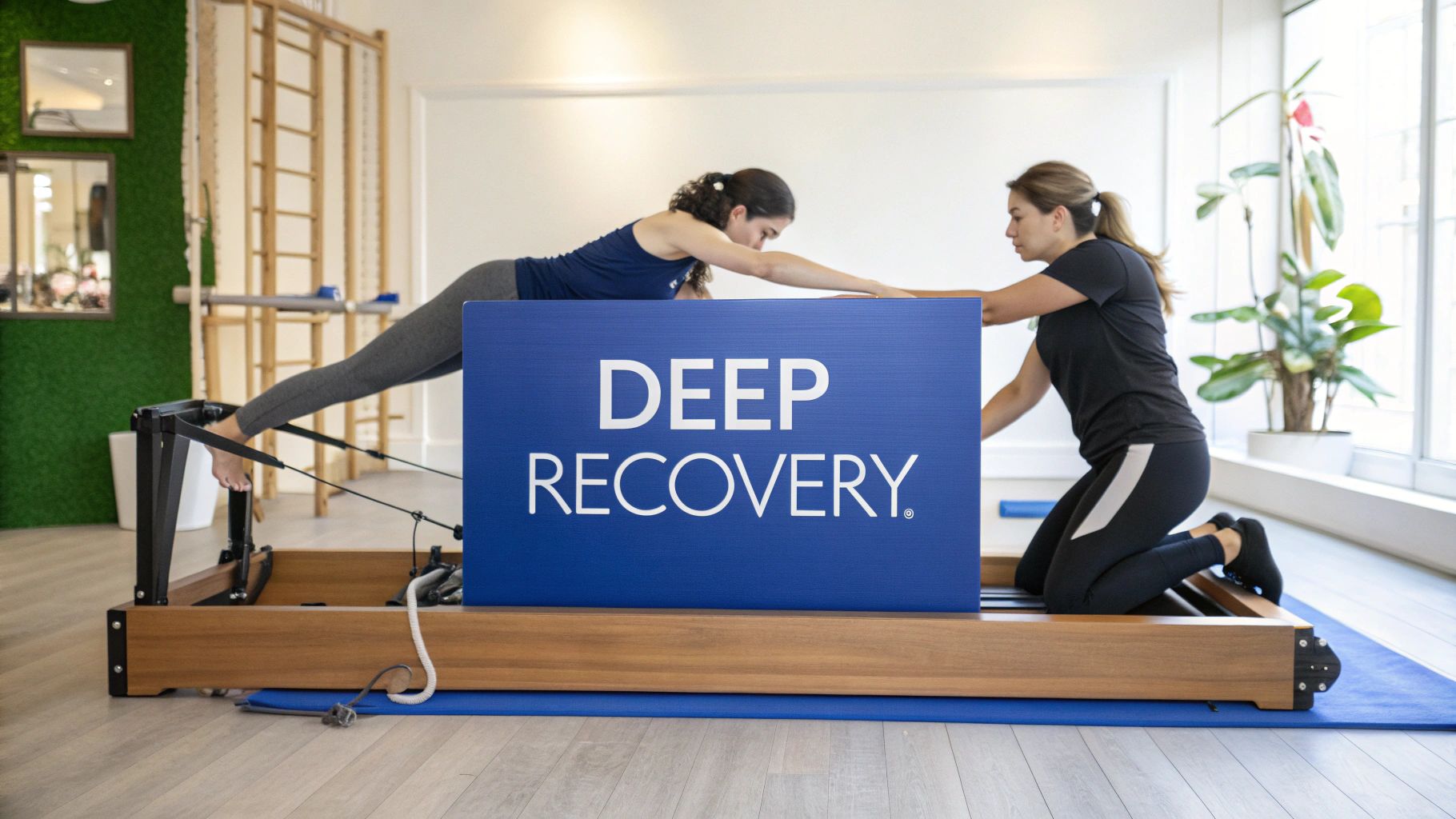
Traditional stretching often hits a plateau, leaving you with nagging tightness and limited mobility. While static floor stretches have their place, they can lack the precision and support needed to achieve a truly deep, effective release. The Pilates reformer changes the game by providing a controlled, dynamic environment that goes far beyond what a mat can offer. It uses spring resistance and a gliding carriage to facilitate targeted elongation, allowing you to safely access deeper ranges of motion in key muscle groups.
This guide moves past generic advice to deliver a practical roundup of essential pilates reformer stretching exercises. Each entry is designed to improve flexibility, accelerate recovery, and enhance overall athletic performance. We provide clear, actionable cues, detail common mistakes to avoid, and explore progressions for all fitness levels. You'll learn how to execute these movements with precision to alleviate chronic pain from desk-bound stiffness or intensive training. For facilities looking to maximize client outcomes, we also touch on how these routines can be paired with advanced recovery technologies, such as vacuum therapy, to create a powerful synergy for whole-body wellness. Whether you're an athlete, a wellness professional, or someone seeking relief, this is your blueprint for profound mobility.
1. Supine Hamstring and Hip Flexor Stretch
The Supine Hamstring and Hip Flexor Stretch is a foundational movement in any repertoire of Pilates reformer stretching exercises. Performed lying on your back on the carriage, this exercise uses the reformer’s footbar and spring tension to create a controlled, deep stretch that simultaneously targets the hamstrings, hip flexors, and lower back. This dual-action stretch is highly efficient for post-training recovery, especially for athletes and individuals with lower body tightness.
Unlike static mat stretches, the reformer provides gentle assistance and stability, allowing you to isolate and lengthen muscles more effectively and safely. This controlled environment minimizes the risk of overstretching or compensatory movements, making it a superior choice for both injury prevention and rehabilitation. It’s an essential cool-down tool used by athletic departments and a core component of recovery packages in medspas.
How to Perform the Stretch
- Set Up: Lie supine (on your back) on the reformer carriage with your head on the headrest. Place one foot on the footbar with the knee bent. Place the other foot in a strap and extend that leg straight up toward the ceiling.
- Hamstring Stretch: Keeping the leg straight, gently press the carriage away by extending the foot on the footbar. You will feel a deep stretch along the back of the leg that is in the strap. Hold this position, breathing deeply.
- Hip Flexor Stretch: To target the hip flexor, lower the strapped leg toward the footbar while keeping it straight. The focus now shifts to the front of the hip of the leg that is on the footbar.
Practical Tips for Optimal Results
- Maintain a Neutral Spine: Press your lower back gently into the carriage to avoid arching. This isolates the stretch in the targeted muscles.
- Use Light Spring Tension: Start with one light spring (red or blue). The spring should assist, not resist, the movement.
- Breathe Deeply: Inhale to prepare and exhale to deepen the stretch. Hold each position for 30–60 seconds for maximum benefit.
- Post-Treatment Pairing: Perform this stretch after a Vacustyler session. The enhanced circulation from vacuum wave therapy warms the muscles, making them more pliable and receptive to stretching. This combination is highly effective if you want to learn how to reduce muscle soreness and accelerate recovery.
2. Spine Stretch Forward with Carriage Control
The Spine Stretch Forward with Carriage Control is a profound movement within the Pilates reformer stretching exercises repertoire, designed to decompress and lengthen the spine. Performed either seated or supine, this exercise utilizes the reformer’s spring resistance to create eccentric loading, which allows for a controlled, progressive spinal flexion. This technique deepens the stretch through each vertebra while ensuring core stability.
Unlike unsupported forward folds on a mat, which can risk compression, the reformer offers precision and safety. This makes it particularly valuable for professionals with sedentary desk postures who need to relieve spinal tension and restore mobility. Wellness centers often use this exercise as a centerpiece in stress-relief classes, while biohacking studios include it in longevity-focused mobility protocols to maintain spinal health.
How to Perform the Stretch
- Set Up: Sit on the carriage facing the footbar with your legs extended straight, feet against the shoulder rests. Hold the straps or handles attached to the springs.
- Initiate Flexion: Inhale to lengthen your spine. As you exhale, begin to round your spine forward, starting from the crown of your head and articulating vertebra by vertebra.
- Controlled Extension: The carriage will move slightly as you extend forward. Use your core to control the movement, allowing the springs to provide a gentle, pulling resistance that deepens the stretch in your back.
Practical Tips for Optimal Results
- Begin with Light Resistance: Start with a very light spring (yellow or blue) and increase the tension gradually over weeks as your flexibility improves.
- Move Slowly: Maximize the stretch benefit by aiming for a slow, 5-10 second controlled movement as you round forward and return to the starting position.
- Engage Your Core: Gently engage your abdominal muscles throughout the exercise to protect your lumbar spine and maintain stability.
- Pair with Recovery Therapies: This stretch is ideal as a final relaxation element after an Intermittent Vacuum Therapy (IVT) session. The enhanced circulation from IVT can significantly improve joint mobility and flexibility, making your spine more receptive to this deep stretch. To explore more about this synergy, you can read about how IVT enhances joint mobility and flexibility.
3. Quadriceps and Hip Flexor Release on the Reformer
The Quadriceps and Hip Flexor Release is one of the most effective Pilates reformer stretching exercises for targeting the entire front of the leg and hip. This exercise uses the reformer’s carriage and footbar to create a deep, stable stretch that elongates the quadriceps and iliopsoas muscles. It is particularly critical for athletes like runners and cyclists, as well as individuals who experience lower-back pain from prolonged sitting, which often leads to tight hip flexors.
Unlike a traditional standing quad stretch, the reformer provides unparalleled stability, allowing you to maintain proper pelvic alignment and prevent arching in the lower back. This controlled environment ensures the stretch is isolated in the anterior thigh and hip, maximizing its effectiveness and safety. Athletic departments and recovery facilities frequently integrate this stretch into pre-competition mobility routines and cyclist recovery packages to prevent injury and enhance performance.
How to Perform the Stretch
- Set Up: Kneel on the reformer carriage facing the footbar, with one knee near the shoulder blocks and the other foot on the floor. Place the top of the back foot against the shoulder block. Hold the footbar with both hands for stability.
- Initiate the Stretch: Gently press the carriage back with your kneeling leg, keeping your torso upright. You will feel a deep stretch along the front of your thigh and hip on the kneeling side.
- Deepen the Stretch: To intensify the stretch, engage your glutes and core to tuck your pelvis slightly forward (posterior tilt). This action will further isolate and lengthen the iliopsoas muscle.
Practical Tips for Optimal Results
- Maintain a Neutral Pelvis: Use light core engagement to prevent your pelvis from tilting forward, which can strain the lower back. The goal is to feel the stretch in the muscle, not the joint.
- Use Light Spring Tension: Start with one light spring (blue or yellow). The tension should be just enough to provide control as you move the carriage.
- Hold and Breathe: Hold the stretch for 45–90 seconds on each side, breathing deeply to help the muscles relax and release.
- Pre-Treatment Pairing: Perform this stretch before a Vacustyler session. Lengthening the quadriceps and hip flexors beforehand improves tissue receptivity, allowing the vacuum therapy to enhance circulation and accelerate recovery more effectively in these dense muscle groups.
4. Adductor and Inner-Thigh Deep Stretch
The Adductor and Inner-Thigh Deep Stretch is a specialized movement within the catalog of Pilates reformer stretching exercises, targeting a muscle group often neglected. Performed using various reformer setups, this stretch focuses on the adductor complex, which runs along the inner thighs. These muscles are frequently tight in both athletes and sedentary professionals, contributing to hip immobility and potential groin strain.
Unlike unsupported floor poses like the butterfly or frog stretch, the reformer provides unparalleled stability and control. This support allows for a safer, deeper elongation of the adductors without compromising spinal alignment or stability. This makes it an invaluable tool for both functional recovery and aesthetic goals. Medspas often market this stretch in "inner-thigh contouring packages," while athletic departments for sports like soccer and hockey use it for critical injury prevention.
How to Perform the Stretch
- Set Up: Kneel on the carriage facing the side, with one knee against the shoulder rest. Place the foot of the other leg onto the stationary platform or footbar, with the leg extended out to the side. Your hips should be square and facing forward.
- Initiate the Stretch: Keeping your torso upright and core engaged, gently press the carriage away from the platform with your kneeling leg. This movement will create a deep, controlled stretch along the inner thigh of your extended leg.
- Hold and Breathe: Go only as far as you feel a comfortable stretch, not pain. Hold the position, breathing deeply to help the muscles relax and release. Slowly return the carriage to the starting position before switching sides.
Practical Tips for Optimal Results
- Start Conservatively: The adductors are sensitive. Begin with a very light spring or no spring at all to control the movement and avoid overstretching.
- Hold for Longer: To facilitate a deep release in these dense muscles, aim to hold the stretch for 60–90 seconds on each side.
- Maintain Pelvic Alignment: Keep your hips level and facing forward throughout the movement. Avoid tilting the pelvis or arching your back, as this will reduce the effectiveness of the stretch.
- Enhance Contouring Results: For aesthetic improvements, perform this stretch immediately before a Vacustyler session. The increased circulation from the stretch primes the inner thigh area, potentially enhancing the contouring and firming effects of the vacuum wave therapy.
5. Glute and Piriformis Deep Stretch Series
The Glute and Piriformis Deep Stretch Series is a critical sequence in any collection of Pilates reformer stretching exercises, designed to release tension in the deep hip rotators. This series uses the reformer’s footbar and moving carriage to safely guide the hips into multiple angles of elongation, targeting the gluteal muscles and the underlying piriformis. This is vital for clients suffering from hip immobility, sciatica-like symptoms, or lower back pain, as these muscles are often the source of dysfunction.
Unlike traditional mat-based "figure-four" stretches, the reformer provides a stable, controlled environment that allows for a deeper and more precise release without compromising spinal alignment. The smooth glide of the carriage helps ease into the stretch gradually, minimizing muscle guarding. This makes it a cornerstone movement in physical therapy clinics for post-injury recovery and in athletic departments for maintaining essential lower-body mobility and performance.
How to Perform the Stretch
- Set Up: Lie on your back on the carriage with your head on the headrest. Place one foot flat on the footbar with the knee bent. Cross the other ankle over the thigh of the footbar leg, creating a "figure-four" shape.
- Initiate the Stretch: Place your hands on the carriage or frame for stability. Gently press the carriage away from the footbar by extending the leg that is on the footbar.
- Deepen and Hold: As the carriage moves, you will feel a deep stretch in the glute and piriformis of the crossed leg. Control the movement and breathe deeply into the stretch, holding the position where you feel a strong but comfortable release.
Practical Tips for Optimal Results
- Hold for Longer: The glutes and piriformis are dense muscles that respond best to prolonged holds. Aim to maintain each stretch for 60–120 seconds to allow the muscle fibers to release fully.
- Maintain Hip Alignment: Keep both hips level on the carriage. Avoid tilting or hiking one hip to compensate, as this reduces the effectiveness of the stretch.
- Progress Slowly: These are powerful stretches. It is better to work with moderate intensity consistently over 2–3 weeks rather than forcing a deep stretch too soon.
- Schedule Pre-Treatment: Performing this series before a Vacustyler session can be highly beneficial. The stretches increase local circulation and tissue pliability, preparing the lower body to receive the maximum circulatory benefits from the vacuum wave therapy.
6. Lateral Hip and IT Band Release with Carriage
The Lateral Hip and IT Band Release is a highly targeted movement within the Pilates reformer stretching exercises repertoire. It directly addresses tightness in the lateral hip, tensor fasciae latae (TFL), and the iliotibial (IT) band, areas that are notoriously tight in runners, cyclists, and individuals who sit for long periods. Using the reformer’s carriage and footbar, this exercise facilitates a safe and progressive lateral elongation that is difficult to achieve with traditional mat stretches.
This stretch is often more effective than foam rolling because it combines gentle, sustained lengthening with neurological relaxation, teaching the muscle to release tension rather than just compressing it. Its ability to alleviate lateral knee pain and lower back discomfort makes it a staple in athletic recovery. Running clubs and cycling teams use it as a standard protocol for injury prevention, while wellness centers feature it in specialized "runner's recovery" packages alongside Vacustyler treatments to improve lower-body circulation.
How to Perform the Stretch
- Set Up: Kneel sideways on the carriage with one knee bent and the corresponding foot against the shoulder rest. Place the other foot flat on the floor or on the reformer frame. Your hands can be placed on the footbar for stability.
- Initiate the Stretch: Keeping your torso upright and core engaged, gently press the carriage away from the footbar by extending the leg on the floor. This movement creates a deep stretch along the outside of the hip and thigh of the kneeling leg.
- Hold and Deepen: Hold the stretch at a point of comfortable tension, breathing deeply to encourage the muscles to relax and lengthen. Avoid leaning your torso forward or backward to maintain focus on the lateral hip complex.
Practical Tips for Optimal Results
- Start Conservatively: Position the carriage close to the footbar initially. As your flexibility improves, you can start with the carriage further away to achieve a deeper stretch.
- Hold for Longer: The dense connective tissue of the IT band responds best to sustained holds. Aim for 60–90 seconds per side.
- Be Consistent: For those prone to IT band tightness, like runners and cyclists, perform this stretch 3–5 times per week. This consistency is a key component of effective athletic recovery. For more tips, learn how to prevent sports injuries with a proactive approach.
- Maximize Circulation: Schedule this stretch before a Vacustyler session. Opening up the IT band and lateral hip can improve lower-body circulation, allowing the subsequent vacuum therapy to be even more effective at flushing metabolic waste and enhancing tissue recovery.
7. Spinal Rotation and Oblique Stretch on the Carriage
The Spinal Rotation and Oblique Stretch on the Carriage is a sophisticated movement among Pilates reformer stretching exercises, designed to enhance rotational mobility and core stability. Performed while kneeling or sitting on the moving carriage, this stretch utilizes the reformer’s straps and spring tension to facilitate a deep, controlled twist through the torso. This dynamic action targets the obliques, spinal rotators, and lateral core muscles, making it highly effective for anyone experiencing spinal stiffness.
This exercise is particularly beneficial for desk workers and rotational sport athletes (golf, tennis, baseball) who often develop imbalances and tightness in their core. Unlike static floor twists, the reformer provides gentle resistance and proprioceptive feedback, guiding the body through a safe and effective range of motion. This controlled environment enhances core coordination and spinal decompression, which is why biohacking studios feature it in mobility-focused longevity protocols and athletic departments use it to improve performance and prevent injury.
How to Perform the Stretch
- Set Up: Kneel on the carriage facing the side, with your knees hip-width apart and your body perpendicular to the springs. Hold one strap in the hand furthest from the risers. Your other hand can be placed on your hip for stability.
- Initiate Rotation: Keeping your hips stable and facing forward, engage your core. Pull the strap across your body, initiating a slow and controlled rotation through your spine. Allow your head and shoulders to follow the movement.
- Deepen the Stretch: As you rotate, focus on lengthening your spine upward to create space between the vertebrae. You will feel a deep stretch along the side of your torso and obliques. Hold the peak rotation briefly before slowly returning to the starting position.
Practical Tips for Optimal Results
- Prioritize Control Over Intensity: Begin with light spring resistance (one yellow or blue spring). The goal is to control the movement, not to pull a heavy load.
- Move Slowly and Deliberately: This is a stretch, not a strength exercise. Move through the rotation slowly, holding the deepest point for 5 seconds to allow the muscles to release.
- Engage Your Core: Actively pull your navel toward your spine throughout the exercise. This stabilizes your lumbar spine and ensures the rotation comes from your mid-back (thoracic spine), not your lower back.
- Coordinate with Your Breath: Exhale as you rotate to deepen the stretch and release tension. Inhale as you return to the starting position. This mindful breathing enhances the effectiveness of the exercise.
7-Exercise Reformer Stretch Comparison
| Exercise | 🔄 Implementation Complexity | ⚡ Resources & Efficiency | ⭐ Expected Effectiveness | 📊 Expected Outcomes / Impact | 💡 Ideal Use Cases & Tips |
|---|---|---|---|---|---|
| Supine Hamstring and Hip Flexor Stretch | Low — basic alignment and carriage use | Reformer, light springs; quick setup, time-efficient | ⭐⭐⭐⭐ | Improves hamstring/hip-flexor length; lowers post-workout tightness; aids recovery with Vacustyler | Athletes post-training, medspas. Tip: neutral spine, hold 30–60s, use light spring after Vacustyler |
| Spine Stretch Forward with Carriage Control | Moderate — requires guided technique for safe spinal flexion | Reformer, adjustable springs, instructor oversight; slower tempo (time moderate) | ⭐⭐⭐⭐ | Spinal decompression, posture improvement, reduced lumbar tension | Desk-workers, stress-relief classes. Tip: 5–10s descents, engage core, start with light resistance |
| Quadriceps and Hip Flexor Release on the Reformer | Moderate — pelvis alignment critical to avoid strain | Reformer footbar, targeted positioning; efficient for athletes | ⭐⭐⭐⭐ | Reduces anterior knee pain and hip-flexor tightness; lowers low-back strain | Runners, cyclists, athletic prep. Tip: maintain neutral pelvis, hold 45–90s, perform pre-Vacustyler |
| Adductor and Inner-Thigh Deep Stretch | Moderate — careful progression to protect inguinal structures | Reformer side/footbar, longer holds; accessible but sensitive tissue | ⭐⭐⭐⭐ | Groin-strain prevention, improved hip rotation; aesthetic inner-thigh contouring when paired with Vacustyler | Soccer/hockey athletes, medspa packages. Tip: start gently, 60–90s holds, 3–4× weekly |
| Glute and Piriformis Deep Stretch Series | Moderate–High — multiple angles require informed instruction | Reformer, varied positions, instructor-led progressions; longer session time | ⭐⭐⭐⭐ | Rapid symptomatic relief for sciatica/lower-back; improves hip stability and mobility | PT clinics, athletes with sciatic symptoms. Tip: 60–120s holds, progress over 2–3 weeks, combine active/passive work |
| Lateral Hip and IT Band Release with Carriage | Moderate — sidelying stability and carriage control needed | Reformer, careful carriage increments; effective alternative to foam rolling | ⭐⭐⭐⭐ | Alleviates lateral knee pain and hip bursitis; improves lateral hip mobility | Runners/cyclists, injury-prevention programs. Tip: progress carriage conservatively, hold 60–90s, pair with hip strengthening |
| Spinal Rotation and Oblique Stretch on the Carriage | High — requires strong core control and slow execution | Reformer, spring selection, close supervision; dynamic but controlled | ⭐⭐⭐⭐ | Enhances spinal rotation, core coordination, reduces rotational stiffness | Rotational-sport athletes, mobility-focused studios. Tip: use light springs, 5s holds at endpoints, maintain core engagement |
Integrating Advanced Stretching into Your Recovery Protocol
You have now explored a comprehensive suite of Pilates reformer stretching exercises, each designed to unlock new levels of flexibility, mobility, and recovery. From the fundamental Supine Hamstring and Hip Flexor Stretch to the dynamic Spinal Rotation on the carriage, these movements offer a precise and controlled method for addressing muscular tightness and fascial restrictions. The reformer’s unique spring system provides both assistance and resistance, creating an unparalleled environment for achieving deep, effective stretches that are often unattainable on a mat alone.
The true value of mastering these exercises lies in their systematic approach. By incorporating movements like the Quadriceps and Hip Flexor Release or the Glute and Piriformis Deep Stretch Series into your routine, you are not just passively elongating muscles; you are actively re-educating your body’s neuromuscular patterns. This translates to improved athletic performance, reduced risk of injury, and enhanced daily function for busy professionals.
Key Takeaways for Immediate Application
For facilities such as medspas, athletic departments, and wellness centers, these exercises represent more than just a new service offering. They are a powerful tool for delivering tangible, high-value results that clients can feel immediately. Consider these actionable next steps:
- Create Targeted Mini-Routines: Use the sample routines provided earlier as a template. Design a 15-minute "Athlete Warm-Down" focusing on the Supine Hamstring and Lateral Hip stretches, or a 10-minute "Desk Worker Decompression" centered on the Spine Stretch Forward and Spinal Rotation.
- Emphasize Mindful Execution: The difference between a good stretch and a great one is intention. Coach clients to focus on their breath and the sensation of release, ensuring they avoid common errors like forcing a stretch or losing core engagement. Proper execution of pilates reformer stretching exercises is paramount for safety and efficacy.
- Integrate for Synergistic Results: The ultimate power of these stretches is unlocked when they become part of a holistic recovery ecosystem. Use them as a preparatory step to enhance the effectiveness of other modalities.
A New Standard in Recovery Synergy
Think of these reformer stretches as the key that unlocks your tissue’s potential. By performing a targeted routine before a session with advanced recovery technology, you prepare the muscles and fascia, making them more receptive to treatment. For instance, pre-stretching can dramatically enhance the circulatory and lymphatic benefits of technologies that use vacuum and light therapy. Following a technology-driven session, a gentle reformer stretch helps to lock in the gains, promoting lasting improvements in mobility and circulation. This integrated approach elevates the client experience from a simple service to a sophisticated, science-backed recovery protocol that delivers superior outcomes and sets your facility apart as a leader in wellness innovation.
Ready to elevate your recovery protocols and offer a truly integrated wellness experience? Discover how the Vacustyler system from Weyergans HighCare US synergizes perfectly with pilates reformer stretching exercises to accelerate recovery, enhance circulation, and deliver unparalleled client results. Explore the future of holistic wellness at Weyergans HighCare US.