


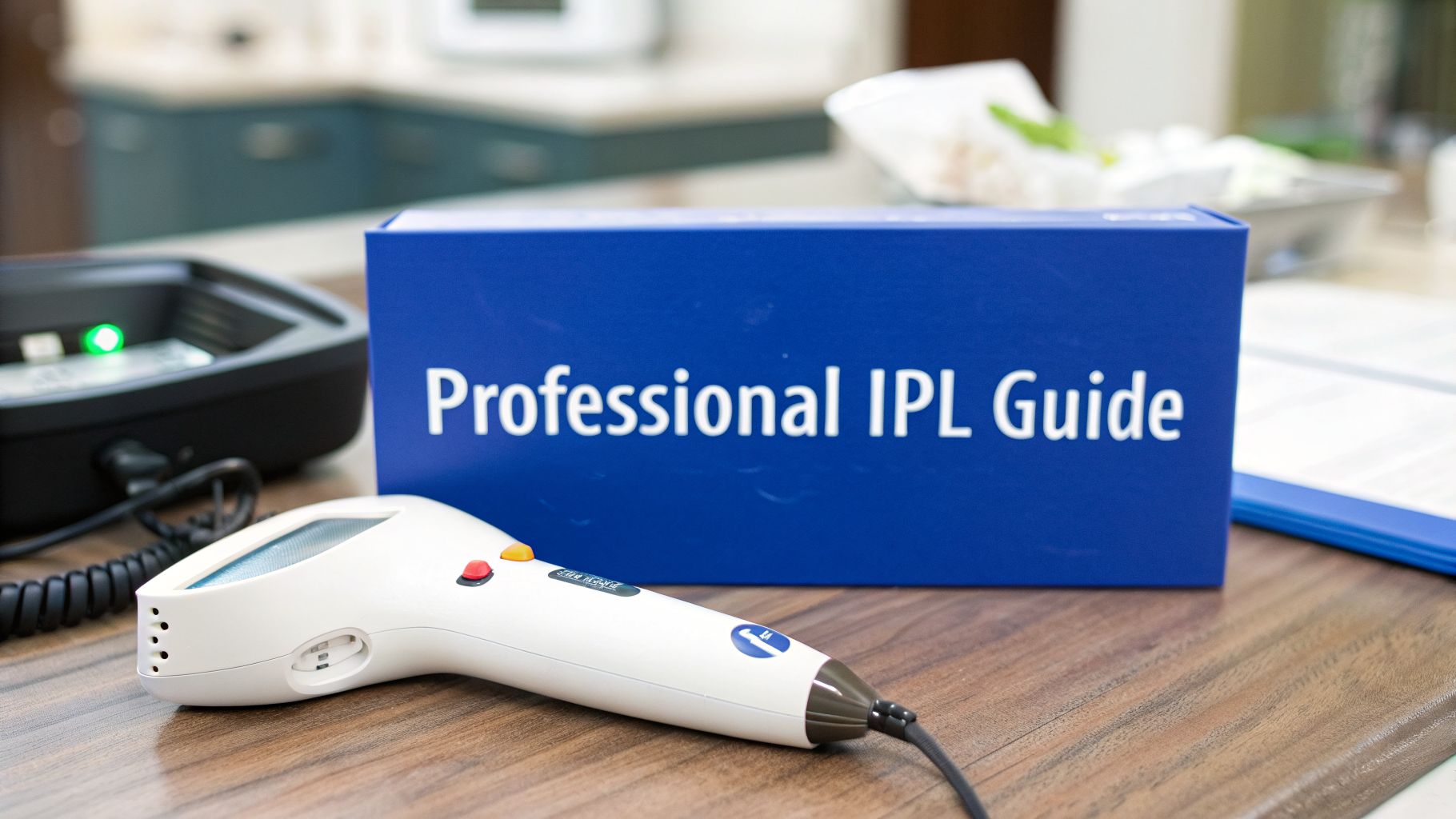
A professional IPL machine is not a laser. Think of it less as a pinpoint beam and more like a sophisticated, powerful camera flash. It uses a broad spectrum of light that can be filtered to zero in on specific skin concerns, from unwanted hair to pigmentation. This versatility is why it's a cornerstone technology in many modern aesthetic practices.
How a professional IPL machine really works

To get a feel for how an IPL machine works, picture the difference between a spotlight and a floodlight. A laser is the spotlight—a single, concentrated wavelength of light aimed at a tiny, specific target. An IPL machine is the floodlight. It sends out a broad spectrum of light over a much wider area.
The effectiveness comes from a principle called selective photothermolysis. The machine delivers a powerful, controlled pulse of light energy, which is then absorbed by specific targets, or chromophores, within the skin.
Chromophores are the colored elements in the skin that naturally attract light. In aesthetics, the two we care about most are:
- Melanin: This is the pigment that gives hair and skin its color. By targeting melanin, IPL can generate heat to damage hair follicles, leading to hair reduction. It’s also good for breaking up clusters of pigment like sun spots and freckles.
- Hemoglobin: This is the protein in red blood cells. By targeting hemoglobin, IPL is a good choice for treating vascular issues like broken capillaries, spider veins, or the redness from rosacea.
When the light energy hits these targets, it instantly converts into heat. This controlled thermal effect destroys the target, whether it's a hair follicle or a tiny blood vessel, while leaving the surrounding skin tissue unharmed.
The function of filters and handpieces
A professional IPL device is not a one-trick pony. Its versatility comes from interchangeable filters or handpieces. These filters are designed to block certain wavelengths of light, allowing only the most effective ones for a specific treatment to pass through to the skin.
For example, a filter for hair removal will allow wavelengths that are strongly absorbed by melanin. For a client with vascular lesions, you'd swap it for a filter that permits light best absorbed by hemoglobin. This ability to customize the light output lets a single machine handle everything from photorejuvenation to acne management.
The real differentiator for a professional IPL machine is its capacity to deliver high energy (fluence) with precise control over the pulse duration. This combination ensures enough heat is generated to be effective without causing unnecessary discomfort or skin damage—a level of precision that at-home devices cannot match.
Why professional grade matters
The gap between a professional IPL machine and a gadget you can buy online is immense. Professional systems deliver higher energy levels, which are essential for achieving consistent, long-lasting results. They also have advanced cooling systems, like contact cooling or chilled air, to protect the outer layer of the skin and keep the client comfortable during the procedure.
This power and precision demands a skilled hand. A trained technician knows how to adjust the settings based on a client's skin type (using the Fitzpatrick scale), the specific condition being treated, and the body area. This expert oversight minimizes risks and maximizes outcomes. The potential of light-based therapies is vast, and understanding the core technology is the first step. You can dig deeper into how different light modalities work by reading our article on the benefits of infrared light therapy.
Investing in a professional IPL machine gives your practice the power to deliver safe, reliable, and effective treatments that build client trust. It’s an investment in technology that expands your service menu and solidifies your reputation for delivering results.
Decoding the spec sheet on a professional IPL machine

When you're ready to invest in a professional IPL machine, the spec sheet is where the real story is. It’s time to look past the glossy marketing brochures and get into the numbers that define what a machine can do. These technical details directly impact your treatment outcomes, client safety, and your clinic’s bottom line.
A few key metrics tell you almost everything you need to know about a machine's power, precision, and versatility. Once you get a feel for them, you’ll be able to spot a high-performance workhorse from a mile away.
Core performance metrics
The first number to look for is fluence. Measured in joules per square centimeter (J/cm²), this is the amount of energy density packed into each pulse of light. Think of it as the raw power. Higher fluence helps when tackling stubborn targets like deep, coarse hair or dense pigmentation. But high power, if managed improperly, also increases risks.
Next, find the pulse duration, which tells you how long each flash of light lasts, measured in milliseconds (ms). This is about control. A short, quick pulse is good for zapping small, delicate structures like spider veins. A longer, slower pulse delivers that energy more gently, which gives the surrounding skin time to cool off and is necessary for safely treating clients with darker skin tones.
The magic happens when you can adjust both fluence and pulse duration independently. This gives a skilled technician the control to tailor the treatment perfectly to each client's skin type, hair color, and condition. It's the difference between a one-size-fits-all approach and bespoke, effective care.
A professional IPL machine's value is defined by its range and control. Look for a wide fluence range (e.g., 5-50 J/cm²) and flexible pulse duration settings. This flexibility is what allows you to safely and effectively treat a broad spectrum of clients and conditions.
Spot size and cooling technology
The spot size is the treatment area of the handpiece, measured in square centimeters (cm²). This spec is about efficiency and precision. A larger spot size lets you move through treatments on big areas like the back or legs, cutting down your appointment times.
A smaller spot size gives you the accuracy needed for contoured areas like the upper lip or around the eyebrows. The best systems offer multiple handpieces with different spot sizes, giving you the adaptability to work quickly on large areas and precisely on small ones.
Just as important is the machine's cooling system. A powerful IPL device generates heat, and a good cooling mechanism is non-negotiable for client comfort and protecting the skin. There are three main technologies you'll encounter:
- Contact Cooling: A chilled plate at the tip of the handpiece cools the skin on contact, right before and during the flash. Most experienced techs prefer this method for its reliability and direct skin protection.
- Air Cooling: A constant stream of cold air is blown onto the skin. It works, but it can be less precise than direct contact cooling.
- Cryogen Spray: A quick, targeted burst of cooling spray hits the skin just before the light pulse. This is effective but adds a recurring cost for cryogen canisters.
For a busy clinic, an integrated contact cooling system is usually the most practical and cost-effective choice. It keeps clients comfortable, protects the epidermis, and gives you the confidence to use higher, more effective energy settings safely.
This table breaks down the features to look for on any spec sheet.
Essential IPL machine feature checklist
A guide to the technical specifications that determine a professional IPL machine's performance, safety, and versatility for your clinic.
| Feature | What to Look For | Why It Matters for Your Practice |
|---|---|---|
| Fluence (J/cm²) | A wide, adjustable range (e.g., 5-50 J/cm²). | Higher fluence offers more power for resistant targets. A wide range provides versatility for different skin types and conditions. |
| Pulse Duration (ms) | Multiple, adjustable settings (e.g., from 2ms to 60ms). | Short pulses target fine structures; long pulses are safer for darker skin. Independent control is important for precision and safety. |
| Spot Size (cm²) | Multiple handpieces with varied spot sizes. | Large spots increase treatment speed on big areas. Small spots offer precision for detailed work. |
| Cooling System | Integrated contact cooling (sapphire tip). | Protects the epidermis, makes clients more comfortable, and allows for the safe use of higher energy levels for better results. |
| Wavelength Filters | A set of interchangeable filters (530nm, 590nm, 640nm, etc.). | Each filter targets a different chromophore, allowing you to offer a wide variety of treatments (pigment, vascular, hair) with one device. |
| Repetition Rate (Hz) | A fast rate (e.g., up to 10Hz) for in-motion modes. | Enables "in-motion" or "SHR" techniques, making treatments like hair removal much faster and more comfortable for the client. |
Looking at these specs in combination gives you a complete picture of the machine’s capabilities and how it will fit into your daily practice.
Expanding your services with filters and handpieces
The final piece of the puzzle is the machine’s set of interchangeable filters and handpieces. This is where a good machine becomes a great business asset. A top-tier professional IPL machine will include a range of filters that isolate specific wavelengths of light from the broad spectrum.
For instance, you might use a 530 nm filter to target pigmentation and superficial blood vessels for a photorejuvenation facial. Then, in your next appointment, you can swap to a 640 nm filter that’s optimized for hair removal.
This ability to switch treatments on the fly turns a single device into a multi-purpose workhorse. It maximizes your ROI and lets you build a diverse service menu that attracts a wider range of clients. When you're evaluating a machine, always ask about the range of filters included and if you can purchase more down the line to expand your practice.
Meeting safety and regulatory requirements

Operating a professional IPL machine safely and legally is the foundation of a trustworthy practice. This goes beyond just knowing which button to press. It’s about a strict commitment to federal regulations, state laws, and clinical best practices.
Building a culture of safety protects your clients, your staff, and your business from liability. Remember, a professional IPL machine is a powerful medical device, and regulators treat it as such. This isn't just about good practice; it's about the law.
Understanding FDA clearance
In the United States, any professional IPL machine you consider must have clearance from the Food and Drug Administration (FDA) to be legally sold. The most common pathway is the 510(k) premarket notification. This means the manufacturer has proven their device is "substantially equivalent" in safety and effectiveness to another device already on the market.
A common mistake is thinking FDA clearance is a blanket approval for any use. It's not. The clearance is tied to specific intended uses, like "permanent hair reduction" or "treatment of benign pigmented lesions." Using the device for unapproved applications—what's known as "off-label" use—can open your practice up to legal and insurance risks.
State licensing and staff certification
This is where many clinic owners get into trouble. While the FDA regulates the device itself, the states regulate who can operate it.
These laws vary dramatically. Some states might allow a licensed esthetician to perform IPL treatments, while others, like Florida, have rules classifying IPL as a form of "bodily intrusion" that falls outside an esthetician's scope of practice.
Before you purchase a machine, you have to dig into your state’s specific rules. You need answers to these key questions:
- Who can legally operate an IPL device in my state (MD, RN, esthetician)?
- Is direct medical supervision required during treatments?
- What specific certifications or training hours are mandatory for my staff?
Ignoring these state-specific requirements is a fast track to fines, license revocation, and legal battles. This due diligence is non-negotiable for anyone looking to add a professional IPL machine to their services.
The client consultation and patch test
Your most important safety tool isn't a feature on the machine—it's the thorough consultation you conduct before every treatment. This is your chance to spot contraindications, manage client expectations, and build trust.
The Fitzpatrick scale, a system that classifies skin type based on its reaction to UV light, is the industry gold standard. It's essential for judging a client's risk for side effects like burns or hyperpigmentation.
A solid consultation must always include:
- A complete medical history to screen for photosensitizing medications or conditions.
- A frank discussion about the expected results and the number of sessions.
- Signed informed consent paperwork that clearly outlines all potential risks.
The single most important step before a full treatment is the patch test. Applying a few test pulses to a discreet area lets you see exactly how the client's skin will react. This helps you dial in the safest, most effective settings for their skin.
The demand for these treatments is not slowing down. The market for professional IPL machines is projected to grow at a steady 4.2% annually as more clinics expand their menus. This growth is built on the trust that clients and professionals place in IPL technology when it's performed safely and correctly. For more details, you can read the full market research about professional IPL devices. This foundation of safety and compliance is what allows your practice to confidently meet that growing demand.
Making an IPL machine profitable for your clinic
Bringing a professional IPL machine into your clinic is a significant step. But turning that technology into a reliable revenue stream is the real goal. This isn't just about the treatments you perform; it's about the business strategy you build around them. The right pricing, smart marketing, and a firm grasp of your costs separate a good investment from a great one.
Think of your IPL device not just as another tool, but as a business-within-a-business. It needs its own dedicated plan to thrive.
Designing your IPL pricing strategy
How you price your IPL services says a lot about your clinic and directly shapes your cash flow. There’s no single right answer, so it's about finding the model that best fits your clients and your operational style.
Per-Session Pricing: This is the most straightforward approach. Clients pay for each treatment as they go. It’s easy for everyone to understand and offers a low-barrier entry point for new clients who want to try a service without a major upfront commitment.
Package Deals: Offering a series of treatments (like a package of six hair removal sessions) at a discounted rate is a classic for a reason. It secures revenue upfront, encourages clients to complete the full recommended course for best results, and boosts the lifetime value of each client. This is often the most profitable model.
Membership Tiers: If your clinic is about building long-term relationships, a membership model can be fantastic. For a set monthly fee, a client might receive one IPL photofacial or a certain number of small-area hair removal sessions. This creates predictable, recurring revenue.
Another good tactic is bundling IPL with other services, like a facial or a chemical peel. This increases the value of each appointment and introduces clients to other services you offer.
Calculating your return on investment
To make sure your professional IPL machine is a profitable asset, you have to understand its return on investment (ROI). This goes beyond the initial sticker price. A simple framework can help you see the complete financial picture.
Your initial and ongoing costs will include:
- Machine Cost: The upfront price of the device itself.
- Consumables: Things like flash lamps (which have a limited number of pulses), coupling gel, and any cooling cryogen you might use.
- Staff Time: The cost of your technician's time for every procedure.
- Marketing: The budget you set aside to tell people about your new IPL services.
A clear ROI calculation reveals your break-even point—the number of treatments you need to perform to cover your initial investment. Everything after that is profit for your clinic.
Marketing your IPL services effectively
Your marketing should speak to solutions, not just technology. Clients aren’t buying “selective photothermolysis”; they are buying the confidence that comes with clear skin or the freedom of not having to shave. Frame your message around the real-world problems IPL solves, like sun damage, rosacea, and unwanted hair.
You’re tapping into a market with strong, sustained interest. The global market for IPL devices was valued at USD 1.55 billion in 2024 and is projected to hit USD 2.39 billion by 2034. This growth is a clear signal of consumer demand and investor confidence. You can find more details about the growing IPL device market on intelmarketresearch.com.
Use before-and-after photos (with client consent) on your social media and website—they are powerful social proof. You can also run introductory offers for new clients or create special "photofacial season" campaigns during the fall and winter months when sun exposure is lower.
By building a solid business plan around your device, you set yourself up for long-term success. If you're just starting out, our guide on how to start a wellness center is a good resource for building your business from the ground up. Combining the right machine with a smart financial and marketing strategy is the key to ensuring your investment pays dividends for years to come.
Managing staff training and machine upkeep

Your professional IPL machine is only as good as the person operating it. The skill of your team and the reliability of your device are the two pillars holding up client safety, results, and your clinic’s bottom line. A great technician can work wonders, but even the best operator is helpless with a poorly maintained machine.
Getting the day-to-day right means focusing on both your people and your equipment. This calls for a smart approach to hiring, a commitment to ongoing education, and a preventative maintenance schedule that protects your investment.
Building a skilled and compliant team
When you're hiring technicians, look beyond just their experience with a specific machine. What matters is their background and commitment to safety. A top candidate will have a solid understanding of skin anatomy, physiology, and the physics of light-based therapies. Their knowledge of safety protocols, especially the Fitzpatrick scale, is non-negotiable.
Initial training is mission-critical. The gold standard is training provided directly by the machine’s manufacturer. This is the only way to ensure your staff learns the exact operational quirks, safety features, and clinical protocols for the device you own. Plus, manufacturer certification is often a requirement for your liability insurance.
Training doesn't stop after orientation week. The world of aesthetic technology is always moving forward. Committing to continuous education keeps your team's skills sharp and guarantees they're current on the latest techniques and safety guidelines for providing top-tier care.
Ongoing education could look like:
- Advanced workshops on new treatment protocols.
- Annual refresher courses on safety and contraindications.
- Sending your team to industry conferences to see emerging trends.
- Holding peer review sessions to discuss tough cases and share what works.
A practical machine maintenance checklist
Just like your car, your professional IPL machine needs regular tune-ups to perform at its peak and avoid expensive breakdowns. A simple, consistent routine helps maximize its lifespan and ensures every treatment is both safe and effective. While the specifics will vary by model, this checklist is a good starting point.
Here's what your team should be checking daily and weekly:
- Cleaning the Optics: The sapphire crystal at the tip of the handpiece has to be spotless. Any gel residue can absorb energy, which can cause burns or even crack the crystal. It needs to be cleaned with an approved solution after every client.
- Checking the Cooling System: Make sure the machine’s contact cooling or air-cooling system is working right. A quick temperature check before the day’s first appointment can spot a problem before it affects a client.
- Inspecting Cords and Connections: Look over the power cords and handpiece cables, checking for any frays or damage. A loose connection is more than an interruption—it's an electrical hazard.
- Tracking the Flash Lamp Lifespan: Every flash lamp is rated for a specific number of pulses, something like 200,000 shots. Keep a log. Replacing the lamp before it dies prevents a sudden drop in power and ensures your treatments stay consistent.
Protecting your investment with a service contract
An unexpected breakdown is a business owner's worst nightmare because downtime is lost revenue. A service contract with the manufacturer or a certified third-party technician is one of the smartest investments you can make. These contracts typically cover annual preventative maintenance, emergency repairs, and even loaner machines if yours needs to be sent out.
Think of it as an insurance policy for your revenue stream. It's an upfront cost, but that contract can save you thousands in lost income and repair bills down the road. It is an important part of managing your professional IPL machine as the long-term business asset it is.
Comparing IPL with laser and other light therapies
When you're ready to invest in a new energy-based device, the choices can feel overwhelming. Deciding between a professional IPL machine, a dedicated laser, or an LED system isn’t about finding the single “best” technology. It’s about matching the right tool to the treatments your clients are asking for.
The decision often comes down to versatility versus specificity. A laser is a specialist, purpose-built for one job. A professional IPL machine, on the other hand, is a skilled generalist, capable of handling a wide range of common concerns. Let's break down how they compare for the most popular services: hair removal, skin rejuvenation, and pigmentation issues.
For hair removal
This is one of the biggest revenue drivers in aesthetics. Both IPL and lasers get the job done, but they take different routes.
IPL: Its broad-spectrum light and large spot size make it efficient for treating big areas like the legs, back, and chest. The light is drawn to melanin, so it performs best on clients with fair to medium skin and dark hair. The real advantage here is speed—you can cover a lot of ground quickly, making it a cost-effective workhorse.
Lasers (Diode, Alexandrite, Nd:YAG): Lasers use a single, focused wavelength, which gives them precision. An Alexandrite laser, for instance, is a powerhouse for lighter skin types. An Nd:YAG laser is the gold standard for safely treating darker skin tones (Fitzpatrick IV-VI). While lasers can often achieve results in fewer sessions, their smaller spot sizes can make treating large areas more time-consuming.
For a clinic aiming to serve a diverse community, having both IPL for speed and an Nd:YAG for treating darker skin is a powerful and inclusive combination.
For skin rejuvenation and pigment issues
This is where the versatility of a professional IPL machine shines. Photorejuvenation is a massive market, and IPL is often the go-to tool.
An IPL session can tackle multiple issues at once. Using different filters, you can simultaneously target the hemoglobin in broken capillaries to reduce redness and the melanin in sun spots to clear up pigmentation. It’s a comprehensive anti-aging treatment in a single appointment.
Lasers, in contrast, are the specialists you call in for targeted strikes. A KTP laser might be used to precisely zap individual spider veins, while a fractional laser is brought out for more aggressive skin resurfacing to tackle deep wrinkles and textural problems.
And what about LED? Light Emitting Diode therapy is in a different category. It uses lower-energy, non-thermal light to gently stimulate cellular activity. It's good for calming inflammation, killing acne-causing bacteria, and speeding up healing. Many clinics use LED as an add-on after an IPL or laser treatment, or as the soothing star of a facial. It’s a great supporting player but doesn't create the dramatic corrective results of IPL for pigment or vascular concerns.
IPL vs laser vs LED: A comparison for clinic owners
This table gives a quick overview of how these light-based technologies stack up, helping you choose the right tools for your service menu.
| Technology | Best For | Key Advantages | Considerations |
|---|---|---|---|
| IPL | General hair removal (light skin), photorejuvenation, sun spots, rosacea. | High versatility, fast treatment of large areas, cost-effective. | Less effective on light hair or very dark skin for hair removal. |
| Laser | Specific targets: stubborn hair, dark skin types (Nd:YAG), specific pigments, tattoo removal. | High precision and efficacy for specific targets, safer for darker skin. | Less versatile, higher initial cost, may be slower on large areas. |
| LED | Reducing inflammation, treating acne, promoting healing, general skin wellness. | Non-invasive, no downtime, painless, can be used on all skin types. | Not for hair removal or significant pigment/vascular correction. |
Ultimately, there is no wrong answer—only the right fit for your business goals. If you want to build a versatile practice that can effectively address the most common skin concerns your clients have, a high-quality professional IPL machine is an excellent and profitable foundation.
For clinics looking to specialize further or expand their capabilities to serve an even more diverse client base, adding specific lasers or other non-invasive body treatments makes strategic sense down the road.
Common questions about professional IPL machines
Making a big investment in your practice, like bringing in a professional IPL machine, naturally comes with a lot of questions. You’re not just buying a piece of equipment; you're investing in your business's future. Let's walk through the most common questions we hear from clinic owners to give you the clarity you need to make a smart decision.
What is a realistic ROI timeline?
This is the big one. The timeline for seeing a return on your investment boils down to three things: how you price your services, your client volume, and your operating costs. Most clinics can expect to break even within 12 to 18 months.
The key to hitting that mark—or even beating it—is to think in terms of packages. Selling a series of six hair removal sessions, for instance, secures that revenue upfront. To speed things up, put your marketing muscle behind high-demand services and work hard to keep your schedule full. Every booked appointment and minimized no-show gets you closer to your goal.
How do I choose the right IPL settings for different skin types?
Getting the parameters right is everything. It’s the foundation of both safety and results. The first step, always, is to classify your client's skin using the Fitzpatrick scale. This simple system is your guide to understanding how their skin will react to the light and how sensitive it is.
A conservative patch test isn't just a good idea for new clients—it's a non-negotiable requirement. By applying a few test pulses to a small, discreet area, you get to see exactly how the skin responds. This allows you to fine-tune the settings before you even think about a full treatment, which eliminates risk and ensures you're delivering the perfect energy level for that person.
What are the most profitable IPL treatments to offer?
Your IPL device is a workhorse, but a few services consistently rise to the top as revenue-drivers. The most profitable treatments are usually the ones that address widespread concerns or cover larger areas of the body.
You’ll likely find these three are your biggest winners:
- Photorejuvenation Facials: Everyone is looking for a way to combat sun damage, fine lines, and uneven skin tone. These facials are popular because they tackle all three at once.
- Large-Area Hair Removal: Services for the back, chest, and legs are both efficient to perform with a quality professional IPL machine and can command a much higher price per session.
- Rosacea and Redness Reduction: Many people struggle with facial redness and broken capillaries. Offering an effective solution makes this a very reliable and sought-after service.
By focusing your marketing on these in-demand treatments right from the start, you can give your clinic’s profitability a serious boost.
At Weyergans HighCare US, we believe the best technologies are the ones that support both client wellness and business growth. The Vacustyler Avantgarde beautifully complements aesthetic services like IPL by enhancing circulation and supporting recovery, helping you create a truly comprehensive client experience.
Explore how our advanced recovery systems can elevate your service menu today.