


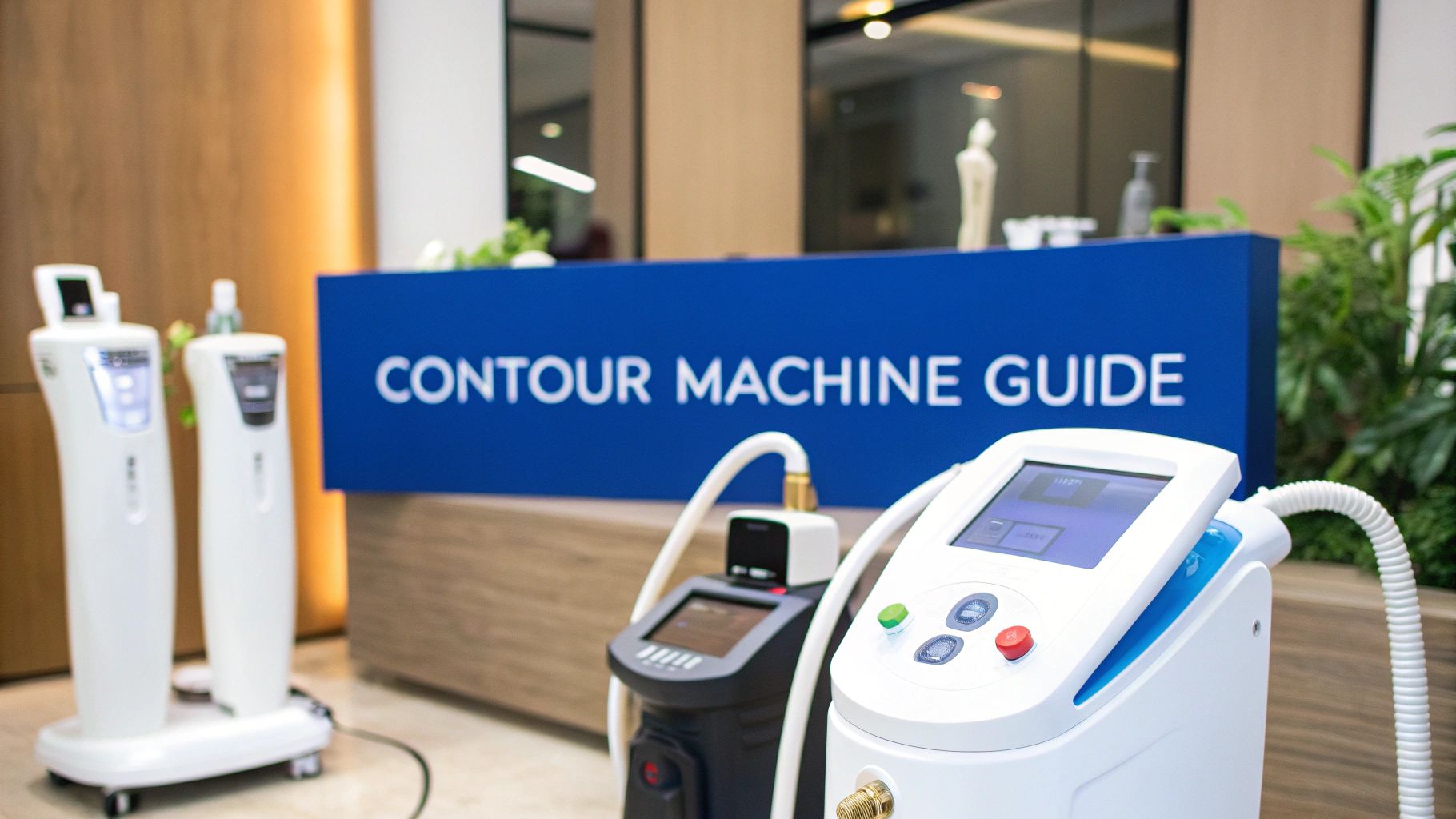
Figuring out which body contouring machine is right for your business comes down to one thing: your goals. The choice between different technologies directly impacts your service offerings, operational workflow, and ultimately, your profitability.
For a business model built around high-volume, unattended wellness services, a vacuum and light therapy pod like the Vacustyler is a natural fit. This technology excels at providing a relaxing, restorative experience that supports circulation and recovery, making it ideal for memberships and service stacking. But if your medspa is laser-focused on targeted fat reduction, you’re probably better off with a Cryolipolysis or HIFU system designed for high-impact, single-session results. The smartest choice always finds the sweet spot between incredible client outcomes, operational ease, and a solid return on your investment.
Choosing the Right Body Contouring Machine for Your Business
Picking the perfect body contouring machine for your medspa, athletic facility, or wellness studio is a major decision. The market is flooded with devices promising the world, but the real value of an investment goes far beyond just what the machine can do. You have to think strategically about how it will fit into your service menu, what it means for your staffing, and how it will actually make you money. In a competitive landscape, the right technology can become a cornerstone of your business, attracting new clients and fostering loyalty.
This guide is designed to give you a clear framework for making that decision. We're going to skip the fluffy feature lists and get straight to a direct comparison of the main technologies out there today. You'll walk away with a real understanding of how each one works, who it’s best for, and the operational headaches—or advantages—it brings to your business. We will delve into the science, financial implications, and practical applications to help you make an informed choice that aligns with your long-term vision.
Setting the Stage for Your Investment
Before you even look at a single machine, you need to get crystal clear on your business objectives. Are you trying to add a high-ticket, hands-on service that requires a dedicated, licensed operator? Or are you aiming for a lower-cost, high-volume offering that can generate passive, recurring revenue through memberships? Your answer completely changes which technology makes sense. Consider your existing client base: are they seeking dramatic aesthetic transformations or holistic wellness and recovery?
To break it all down, we’ll evaluate the top machine categories based on a few core business criteria:
- Mechanism of Action: How does the tech actually get results? Is it destroying fat cells through heat or cold, tightening skin with radio waves, or boosting circulation and lymphatic drainage? Understanding the science is key to marketing the service effectively.
- Client Outcomes: What are the main aesthetic or wellness benefits clients can realistically expect? This includes the immediacy and longevity of results, as well as the overall experience during treatment.
- Operational Model: Does the device need a staff member watching it constantly (attended), or can it run on its own (unattended)? This is a critical factor that directly impacts your labor costs and scalability.
- Return on Investment (ROI): What’s the real profit potential, considering the initial purchase price, session price, client throughput, consumable costs, and staffing requirements? A comprehensive financial analysis is essential.
The most successful businesses don't just buy a machine; they invest in a technology that perfectly aligns with their service philosophy, client base, and financial goals.
By getting a handle on these fundamentals, you can make a confident choice that fuels your growth for years to come. The table below gives a quick snapshot of the technologies we’ll dive into, providing a high-level overview to frame our detailed comparison.
Core Body Contouring Technologies at a Glance
| Technology Category | Primary Business Goal | Operational Style | Staff Involvement |
|---|---|---|---|
| Cryolipolysis | Targeted fat pocket reduction | Single-session, high-ticket | Attended (High) |
| HIFU (Ultrasound) | Fat reduction & skin tightening | Single-session, high-ticket | Attended (High) |
| Radiofrequency (RF) | Skin tightening & cellulite | Package-based, moderate ticket | Attended (High) |
| Vacuum + Light Pods | Circulation, recovery & toning | Membership/Package-based | Unattended (Low) |
This guide will give you the knowledge to properly weigh these options and decide which path—from intensive, targeted treatments to relaxing, unattended wellness sessions—will best serve your business and your clients. Each path offers unique opportunities for growth, but only one will be the perfect fit for your specific vision.
Comparing The Top Body Contouring Technologies
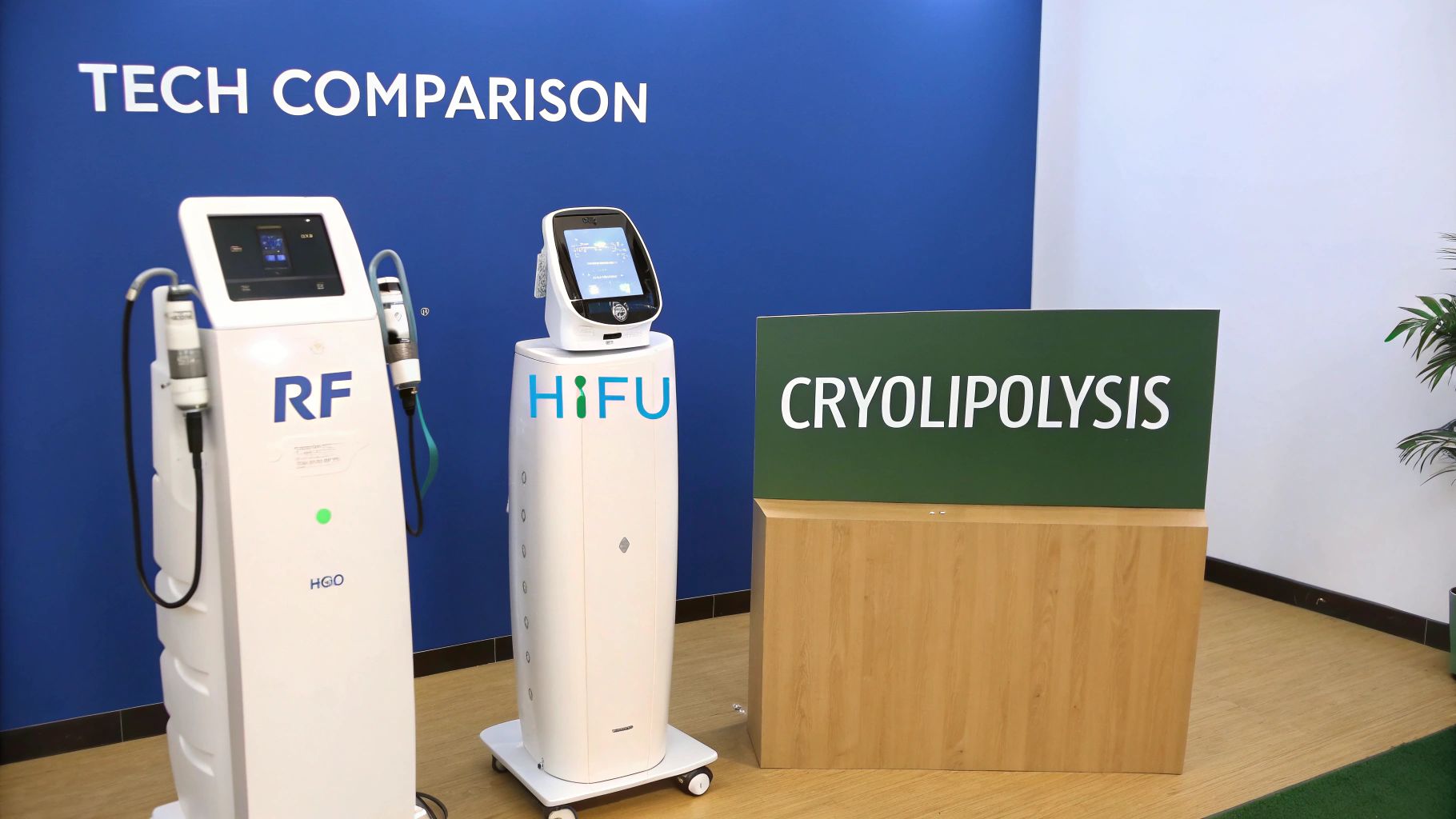
Before you invest in a body contouring device, you have to understand the science behind it. Each technology offers a completely different approach to sculpting the body, targeting specific concerns like stubborn fat, skin laxity, or a mix of both. To find the best fit for your business, you need to look past the marketing hype and get real about how each one works, who it’s for, and what it demands from your team.
This isn't just a fleeting trend. We're seeing a major shift in how people view aesthetic treatments. The global body contouring market was valued at roughly USD 2.12 billion in 2024 and is expected to hit USD 4.64 billion by 2032. That explosive growth—around 13.84% annually—proves that non-invasive solutions are becoming a core part of the modern wellness industry. You can dig deeper into these numbers in this comprehensive industry report. This growth signifies a robust and sustained consumer demand, making it a sound area for business investment.
Let's break down the three most common operator-dependent technologies: Radiofrequency (RF), High-Intensity Focused Ultrasound (HIFU), and Cryolipolysis. Each has a distinct mechanism and a sweet spot where it shines, catering to different client needs and business models.
Radiofrequency The Skin Tightening Specialist
Radiofrequency (RF) is a true workhorse in aesthetics, known for its incredible ability to tighten loose skin and improve the look of cellulite. It works by sending controlled heat deep into the dermal layers.
This warmth kickstarts the production of new collagen and elastin—the proteins that give skin its firmness and bounce. Think of it as waking up the skin's internal scaffolding crew; the heat signals them to start rebuilding and reinforcing the foundation. The thermal energy causes existing collagen fibers to contract, providing an immediate tightening effect, while the long-term benefit comes from the new collagen synthesis that occurs over several weeks.
RF is less about melting away fat and more about refining contours and improving skin quality. It’s a fantastic option for clients post-pregnancy or after significant weight loss who are concerned with skin laxity. Sessions are usually quite comfortable, often compared to a hot stone massage, but they do require a series of treatments for the best results, making it ideal for package-based pricing models.
High-Intensity Focused Ultrasound The Deep Fat Reducer
High-Intensity Focused Ultrasound (HIFU) takes a much more direct approach to fat reduction. It uses focused sound waves to generate heat at a far deeper level than RF, right down in the subcutaneous fat layer.
This precise, intense energy creates tiny points of thermal coagulation, essentially destroying targeted fat cells without harming the surrounding tissue. From there, the body’s lymphatic system naturally clears out these damaged cells over several weeks to months, resulting in a gradual reduction of the fat layer. This process is known as coagulative necrosis.
HIFU is one of the best choices for clients who want noticeable fat reduction and some skin tightening in a single session. However, the treatment can be uncomfortable for some, often described as a deep, warm, tingling sensation. Its power also demands a highly skilled operator to ensure both safety and efficacy, mapping out the treatment area precisely to achieve optimal results.
Key Differentiator: While RF and HIFU both use heat, they operate in completely different zones. RF is a surface-level treatment focused on tightening the skin, while HIFU goes much deeper to directly eliminate fat cells.
Cryolipolysis The Fat Freezing Pioneer
Cryolipolysis, which most people know from brands like CoolSculpting, uses a totally different method: controlled cooling. The technology is based on the fact that fat cells (adipocytes) are far more sensitive to cold than other cells, like skin and muscle.
During a treatment, an applicator suctions a pocket of fat and chills it to a specific temperature that triggers apoptosis, or programmed cell death, in the fat cells. This is a natural, gradual cell death process, not a traumatic necrosis. Just like with HIFU, the body then gradually disposes of these dead cells over the next few months through the lymphatic system.
Cryolipolysis is incredibly effective for isolated, stubborn fat bulges—the classic "love handles" or lower belly pooch that just won't budge with diet and exercise. It's a sculpting tool, not a weight-loss solution. The main things to know are that results take time to appear and the suction can cause temporary bruising, numbness, and redness in the treated area. You can see how it stacks up against other non-invasive body treatments to get a fuller picture.
Technology Showdown Body Contouring Machine Comparison
To make these differences crystal clear, I've put together a simple table breaking down the core features of each technology. It offers a quick, side-by-side view of how they work, who they're best for, and what to expect operationally.
| Technology | Mechanism of Action | Best For | Typical Session Time | Downtime & Side Effects |
|---|---|---|---|---|
| Radiofrequency (RF) | Uses thermal energy to heat the dermis, stimulating collagen and elastin production. | Improving skin laxity, reducing the appearance of cellulite, and mild skin tightening. | 30–60 minutes | Minimal to none; may include temporary redness or warmth in the treated area. |
| HIFU | Delivers focused ultrasound energy deep into the subcutaneous layer to destroy fat cells. | Significant, targeted fat reduction and noticeable skin tightening in a single treatment. | 30–90 minutes | Some discomfort during treatment; temporary redness, swelling, or tingling afterward. |
| Cryolipolysis | Applies controlled cooling to targeted fat pockets, causing fat cells to crystallize and die. | Reducing stubborn, localized fat bulges that are resistant to diet and exercise. | 35–75 minutes per area | Temporary bruising, numbness, redness, and swelling at the application site. |
This at-a-glance comparison should help you start thinking about which approach aligns best with your clinic's goals and the clients you want to serve. Each technology has its strengths, and the best choice will depend on the specific problems your clients want to solve.
The Unattended Advantage of Vacuum and Light Systems
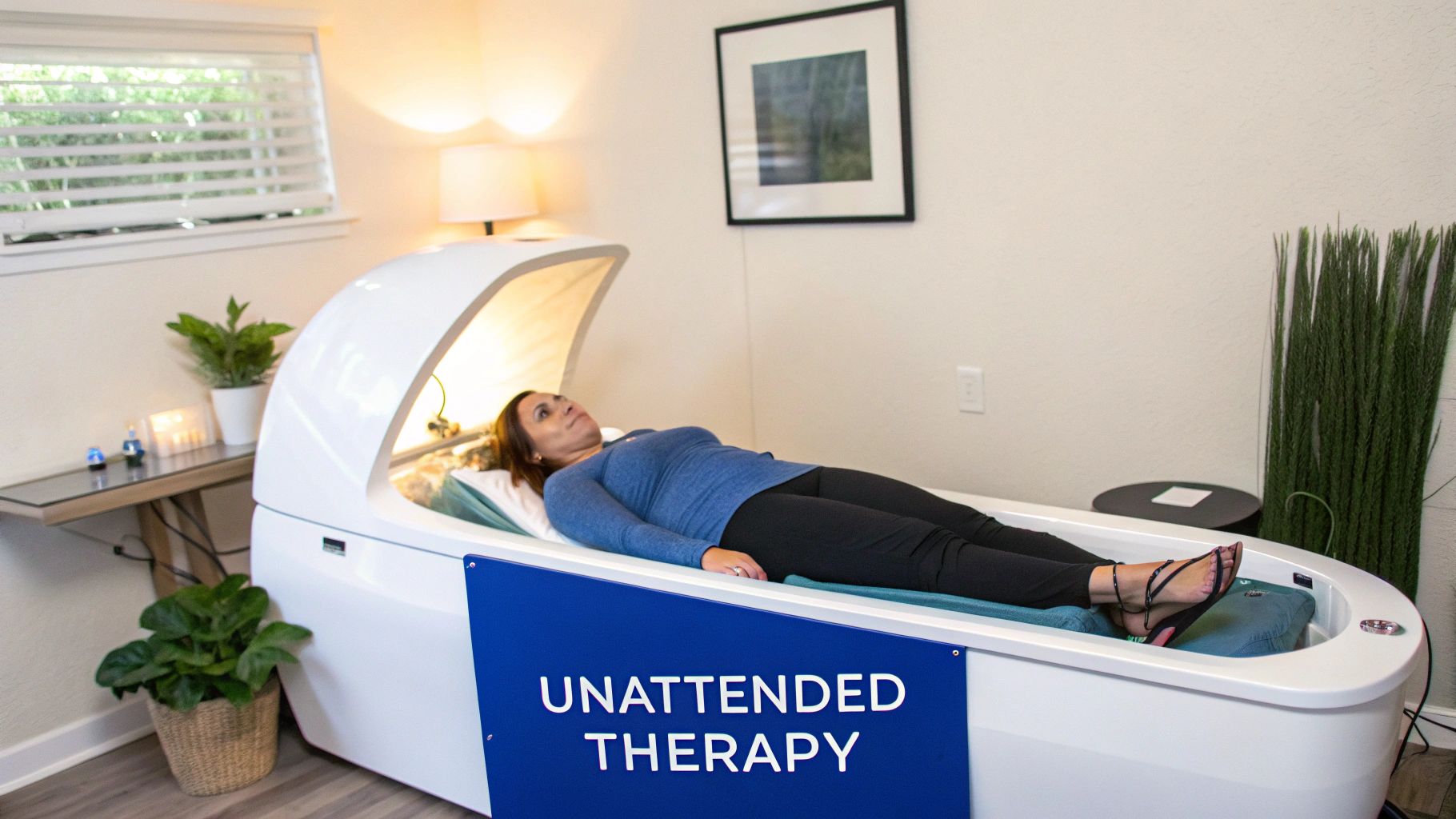
While most body contouring technologies like RF and HIFU require a hands-on technician for every minute of treatment, a different category is carving out a powerful niche by flipping the business model on its head. Vacuum and light systems, like the Weyergans Vacustyler, are less about targeted fat destruction and more about creating a holistic wellness experience that merges aesthetics with recovery.
The game-changer here is its unattended nature. Imagine a high-end service where clients can relax independently, without a dedicated technician tied to the room. This single operational shift opens the door to a high-margin, low-labor model built for recurring revenue through memberships and packages. It allows for a more scalable and efficient use of both your space and your staff.
How Intermittent Vacuum Therapy Works
Instead of relying on extreme temperatures to damage fat cells, these systems use a gentle, biophysical process called intermittent vacuum therapy (IVT). The client simply lies down in a pod-like chamber that seals around their lower body. The machine then begins to cycle between negative pressure (a vacuum) and normal atmospheric pressure.
This rhythmic cycling gives the vascular system a passive workout. During the vacuum phase, blood is drawn into the lower body and its smallest capillaries, effectively dilating the vessels. When the pressure releases, it flows back out, creating a "pumping" action. The result is a powerful boost to circulation and lymphatic drainage—the body's own waste-clearing system. This process is sometimes referred to as passive vascular training.
This enhanced circulatory flow is the secret to its aesthetic benefits. By helping flush out metabolic waste and reducing fluid retention, the therapy promotes a smoother, more toned appearance in the legs, hips, and abdomen. You can get a deeper look at how vacuum therapy helps reduce cellulite and improve overall skin texture.
The Role of Integrated Light Technology
Cutting-edge systems don't stop with vacuum therapy. They often integrate red and infrared light to complement the circulatory benefits, turning each session into a multi-layered treatment. This combination is often referred to as photobiomodulation.
- Red Light (630nm): This specific wavelength works on the skin's surface layers, where it’s known for helping to stimulate collagen production and improve skin elasticity by energizing the mitochondria within skin cells.
- Infrared Light (850nm): Reaching deeper into the tissue, this light helps calm inflammation and support cellular repair processes, which can be beneficial for muscle recovery and reducing minor aches and pains.
The combination makes for a profoundly different client experience. It’s gentle, deeply relaxing, and feels restorative—a world away from the intense sensations associated with other contouring methods. This makes it an appealing option for a broader range of clients, including those who may be hesitant to try more aggressive treatments.
The real power of an unattended system lies in its ability to generate revenue without tying up your most valuable resource: your staff. One employee can manage multiple pods simultaneously, dramatically increasing client throughput and profitability.
A Unique Complementary Service
This approach doesn't have to compete with traditional body contouring; it actually works beautifully alongside it. For a medspa, a vacuum pod can be the perfect add-on after an intensive fat reduction treatment, helping accelerate the body's clearing process and enhance the final results. For a high-end gym or athletic club, it's a powerful recovery tool that doubles as an aesthetic service, appealing to athletes who want to optimize performance and feel their best.
The market is clearly hungry for these kinds of non-invasive solutions. The global body fat reduction market was valued at USD 4.7 billion in 2025 and is projected to hit USD 12.9 billion by 2035, growing at an 11.1% CAGR. This isn't just a niche trend; it’s a reflection of a broad consumer shift toward accessible, effective wellness treatments. By offering a relaxing, unattended service, you tap directly into this expanding market, creating new and sustainable streams of revenue.
Analyzing the Financial Impact on Your Practice

Understanding the science behind different body contouring machines is just the first step. To make a smart investment, you have to dig into the numbers and see how each device will actually impact your bottom line. The sticker price is only one part of the equation; long-term profitability really comes down to operational costs, staffing needs, and client throughput. A machine that looks affordable upfront might become a financial drain if it requires expensive consumables or extensive staff time.
Some of the most popular body contouring machines demand a highly skilled, licensed technician for every single session. This reality ties your revenue potential directly to your payroll. If your lead aesthetician is tied up in a 60-minute HIFU treatment, they can't perform another service, effectively capping what you can earn in that hour.
This is where the business models for these technologies start to look very different. An operator-dependent service forces you to be a master of scheduling and staff management just to maximize your returns. In contrast, a model that leverages unattended technology allows for greater operational leverage and scalability.
Attended Versus Unattended Models
The biggest financial fork in the road is whether a service is attended or unattended. Attended services, like most Cryolipolysis or RF treatments, require one-on-one staff time for the entire session. This makes labor your single biggest ongoing expense and a potential bottleneck to growth.
Unattended systems, like a vacuum and light therapy pod, completely break that dependency. They introduce operational leverage into your business.
An unattended model empowers one staff member to oversee multiple clients at the same time. While one client is relaxing in a 30-minute pod session, that same employee can be checking in another client, administering IV therapy, or setting up a different treatment room. This operational efficiency is a massive advantage for any business looking to scale.
Let's break down two common business models:
- High-Ticket, Low-Volume (HIFU): This model is all about selling premium, one-off treatments or small, expensive packages. The revenue per session is high, but so is the cost to acquire each client and the need for a highly trained operator. Profitability depends on maintaining a high price point and a steady stream of new clients.
- Recurring Revenue, High-Volume (Vacuum Pod): This approach uses the unattended nature of the technology to build a stable membership base. The lower per-session price is balanced by high client throughput and predictable, recurring monthly income. This model focuses on client lifetime value rather than single-transaction revenue.
The most profitable choice depends entirely on your business structure. A boutique medspa might thrive on a high-ticket model, while a wellness center or athletic club will almost certainly see greater returns from a high-volume, membership-driven approach.
Calculating Your True Return on Investment
A true ROI calculation has to look past the machine's price tag. Consumables, for instance, can quietly eat away at your profit margins. Some devices require expensive single-use applicators, gels, or protective membranes for every single treatment, adding a significant variable cost to each service. These costs must be factored into your pricing to maintain profitability.
Systems with minimal or no consumables offer a much clearer path to profitability. An unattended vacuum pod, for example, has incredibly low operating costs per session—mostly just the electricity to run it and the time to sanitize it. This low overhead makes it much easier to achieve a healthy profit margin, even at a more accessible price point.
The good news is that the market for these services is strong and growing, making it a reliable sector for investment. The global body contouring market was valued at USD 8.9 billion in 2024 and is projected to hit USD 14.6 billion by 2033. Non-invasive procedures make up the largest piece of this pie, confirming that consumer demand is squarely behind these technologies. You can dive deeper into the data on this expanding body contouring market.
Strategic Service Bundling for Maximum Revenue
One of the smartest ways to boost your financial return is through strategic service bundling, often called service stacking. The right body contouring machine can become a gateway service that naturally introduces clients to your other offerings.
A gentle, relaxing vacuum pod session, for example, is the perfect complement to more intensive treatments. You can easily bundle it with other services:
- IV Therapy: Administer an IV drip while the client is relaxing in the pod. This maximizes their time and doubles your revenue for that single appointment slot without requiring additional staff.
- Post-Cryolipolysis Drainage: Offer a vacuum session a few weeks after a fat-freezing treatment to help support lymphatic drainage and potentially enhance their results, creating a superior outcome and an additional revenue stream.
- Localized Treatments: A wellness-focused session in a pod can be paired with other targeted services, such as those from a localized cryotherapy machine, creating a comprehensive recovery or aesthetic protocol.
By bundling services, you increase your average revenue per client, elevate their overall experience, and create a more integrated wellness journey within your practice. This approach transforms a single machine from a standalone offering into a central hub for generating multiple streams of income.
Finding the Best Fit for Your Business
Choosing the right body contouring machine isn't about finding a single "best" option. It's about finding the best fit for your specific business model and the clients you serve. A device that’s a star performer in a high-end medspa could be a complete mismatch for a bustling athletic facility. Context is everything.
To make the right call, you have to look past the spec sheets and really visualize how each technology operates in the real world. Think about your clients, your staff, and your goals. Let’s walk through three common business settings to see where different machines truly shine.
The Medspa Setting
In a medspa, the entire focus is on delivering visible, targeted, and often dramatic aesthetic results. Clients walk in looking for a solution to stubborn fat or skin laxity that diet and exercise just haven’t touched. This is the ideal environment for high-ticket, operator-dependent technologies that deliver precision.
- Ideal Machine: This is the natural habitat for Cryolipolysis or HIFU systems. Their power to deliver measurable fat reduction is exactly what medspa clients are paying for. These aren't passive wellness treatments; they're surgical alternatives wielded by skilled technicians.
- Use Case: Imagine a client who wants to finally get rid of that persistent lower belly pooch. A trained technician uses a Cryolipolysis machine to isolate and eliminate fat cells in that specific area over a series of treatments, delivering a clear, undeniable result. The business model is built around selling high-value packages to achieve specific aesthetic goals.
But the smartest medspas know how to build value by bundling services.
For medspas, the real magic happens when you create comprehensive treatment plans. An unattended vacuum and light pod becomes the perfect add-on, used after an intensive fat reduction session to accelerate lymphatic drainage and enhance the client's final results.
The Athletic Facility
Step into a high-performance gym or athletic training center, and the priorities shift completely. The goal here isn’t primarily aesthetics—it's about accelerating muscle recovery, cutting down inflammation, and getting athletes ready for the next challenge. The focus is on functional performance and biological optimization.
- Ideal Machine: An unattended vacuum and light therapy pod, like the Weyergans Vacustyler, is a perfect match. Its ability to boost circulation and supercharge lymphatic drainage directly addresses the core needs of athletes pushing their bodies to the absolute limit. The aesthetic benefits become a valuable secondary selling point.
- Use Case: An endurance athlete just finished a brutal training session. Instead of heading for a standard ice bath, they spend 25 minutes in a vacuum pod. The intermittent negative pressure works to flush out metabolic waste like lactic acid, which helps reduce soreness and gets them back to training faster. The integrated light therapy can also help manage inflammation.
This model is built for memberships and packages, giving athletes a reliable recovery tool they can weave into their daily training regimen.
The Wellness Center
Modern wellness centers and biohacking studios attract a different kind of client—one looking for holistic health optimization. They’re interested in detoxification, better circulation, and overall vitality, and they almost always prefer gentle, non-invasive methods that support the body's innate healing capabilities.
- Ideal Machine: Vacuum and light therapy systems align perfectly with this philosophy. They provide a deeply relaxing, restorative experience that supports the body's natural detox and circulatory processes without the intensity or downtime of other contouring technologies. It fits seamlessly with services like infrared saunas, IV drips, and float tanks.
- Use Case: A client focused on managing fluid retention and detoxification books a weekly session. The gentle cycling of negative pressure supports their circulatory and lymphatic systems, leaving them feeling lighter and more energized. It’s an easy service to pair with other wellness offerings like IV therapy or infrared saunas, creating a powerful wellness circuit that drives repeat business through memberships.
Your Practical Buying Checklist
Buying a major piece of equipment isn't just a transaction; it's a strategic decision that will shape your business for years. Rushing in without a clear framework can lead to a very expensive machine that doesn't actually fit your business model or what your clients truly want.
To cut through the marketing noise, use this checklist. These questions are designed to get you thinking about the real-world impact—operationally and financially—any device will have on your practice.
Target Audience and Desired Outcomes
First things first: who are you serving, and what do they really want? Your clients' goals must be the number one driver behind your technology choice.
- Who is your ideal client? Are you working with athletes who need accelerated recovery, medspa patients looking for stubborn fat reduction, or wellness clients focused on detoxification and feeling lighter?
- What is their main goal? Is it visible fat loss? Tighter skin? Less cellulite? Or is it about enhanced circulation and feeling ready for the next workout? A machine that's a rockstar at one isn't always the best for another.
- What is their tolerance for discomfort and downtime? Answering this will help you choose between intense, results-driven treatments and gentle, restorative experiences.
Operational and Financial Model
Next, let's get practical. How will this machine actually slot into your daily workflow and your bottom line? This is where you figure out if a device makes sense for the business you already have.
The best body contouring machines are the ones that amplify your existing business model, not force you to build a new one from scratch. An unattended system supports a membership model, while a high-touch device fits a premium package structure.
Think through these points carefully:
- Is the operational model attended or unattended? Will it demand a dedicated staff member for every single session, or can one employee comfortably oversee multiple clients at once? This will determine your scalability.
- What are the staffing and training requirements? Does the machine need a licensed esthetician or certified technician to run it, or can your team be trained to operate it with minimal fuss? Consider the cost and availability of qualified personnel.
- What is your pricing strategy? Are you aiming for high-ticket packages that promise targeted results, or are you building a business around more accessible monthly memberships for ongoing wellness and recovery? Your chosen technology must support this strategy.
Vendor Support and Long-Term Partnership
Finally, remember that you’re not just buying a box of electronics. You are starting a long-term relationship with the company behind the machine. A reliable partner is as important as the technology itself.
- What level of training and ongoing support does the vendor provide? Do they offer marketing materials and clinical education?
- Are there any hidden consumable costs you need to budget for? Get a clear list of all ongoing expenses.
- What does the warranty and maintenance plan really cover? Understand the terms for repairs, parts, and service calls.
- What is the vendor's reputation in the industry? Look for reviews and testimonials from other business owners.
Answering these questions honestly will give you the clarity you need to invest with confidence in the right body contouring machine for your unique business.
Answering Your Key Questions
When you're looking to bring new body-contouring technology into your business, you'll naturally have a lot of questions. Let's tackle some of the most common ones we hear from owners weighing their options.
What Is The Difference Between Body Contouring And Weight Loss?
This is probably the most important distinction to make for your clients. Body contouring and weight loss are two completely different goals.
Weight loss is about reducing your overall body mass—something you see on a scale. It involves a caloric deficit and affects the entire body. Body contouring, on the other hand, is about targeted sculpting. It’s for the client who is already at or near their ideal weight but struggles with specific areas that don't respond to diet or exercise. Think stubborn fat pockets on the abdomen, love handles, or thighs; improving skin tone; or refining a silhouette. Contouring reshapes the body, while weight loss shrinks it.
How Much Staff Training Is Required?
The training commitment swings wildly from one technology to another, and it's a major factor in your operational costs and flexibility.
- High-Intensity Devices (HIFU, Laser Lipo, Cryolipolysis): These are not "set it and forget it" machines. They require a skilled, licensed professional—often an esthetician or certified technician—with a deep understanding of anatomy, patient assessment, and specific protocols to operate safely and effectively. The learning curve can be steep, and ongoing education is often necessary.
- Unattended Systems (Vacuum Pods): Here’s where your operational model can really shift. These systems are designed for minimal staff involvement. Training is quick, focusing on getting the client set up, sanitation protocols, and managing the session timer. This frees up your highly-trained staff for more hands-on, premium services, thereby optimizing your labor resources.
Can Different Body Contouring Treatments Be Combined?
Absolutely. In fact, this is where the smartest businesses create a massive competitive advantage. "Service stacking," or combining different modalities, often delivers far better results and significantly boosts your revenue per client. A synergistic approach allows you to address multiple concerns and enhance outcomes.
The real magic happens when you pair technologies strategically. A great example is using a fat-reduction treatment like Cryolipolysis first, then following up with vacuum therapy sessions a few weeks later. The vacuum therapy supports the body’s lymphatic drainage, helping to clear out the treated fat cells more efficiently and really sharpening the final result.
This approach lets you build truly custom treatment plans that solve multiple problems at once, leading to happier clients with more comprehensive outcomes. It also increases the average revenue per client and encourages repeat business, building a more robust and profitable service menu.
Ready to see how an unattended, high-margin wellness system can transform your business? Discover the German-engineered technology at Weyergans HighCare US and explore a versatile solution for recovery, aesthetics, and recurring revenue. Learn more at https://weyerganshighcareus.com.