


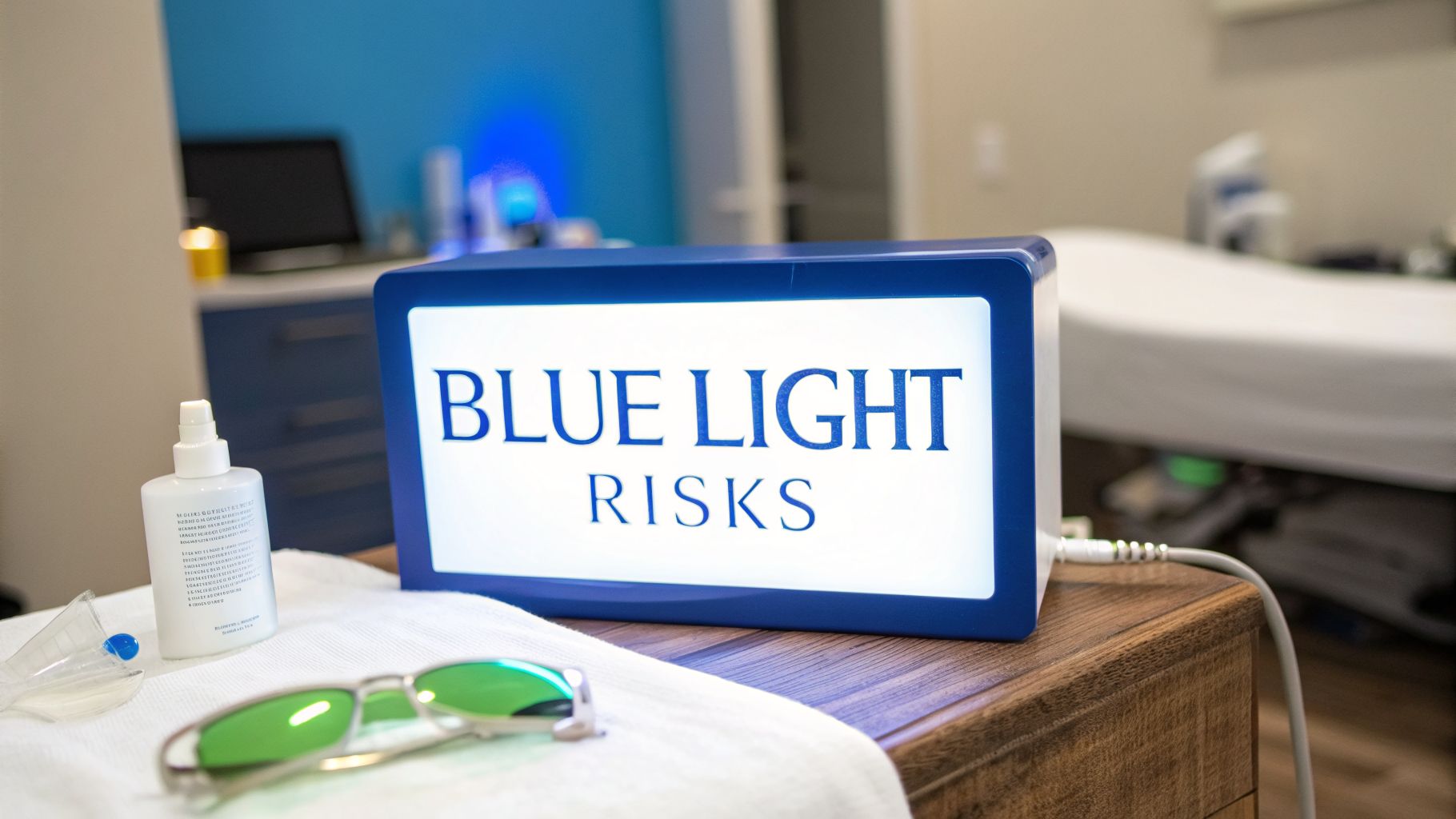
Blue light therapy is widely recognized as a safe and effective tool for treating conditions like acne and psoriasis, but it's good to have a clear picture of what to expect during and after a session. Any therapy powerful enough to create positive change in the skin will cause a temporary response.
These reactions are almost always localized to the treatment area and short-lived. Think of it less as a "side effect" and more as a sign that the therapy is working as intended.
Understanding the potential side effects of blue light therapy

Blue light therapy works by delivering targeted energy into the skin, prompting a specific biological reaction. This controlled, therapeutic stressor clears acne-causing bacteria or calms inflammation, but it also means your skin will go through a brief recovery phase.
Most of these responses are mild and resolve on their own within a day or two. The intensity can vary, especially when comparing a standard blue light session to photodynamic therapy (PDT), which uses a topical photosensitizing agent to produce a much stronger, deeper response.
Common and less common reactions
Knowing the full spectrum of potential reactions helps set realistic expectations for your clients. The most common effects are the skin's natural healing process in action.
You can confidently tell clients to expect minor, temporary reactions like:
- Redness (Erythema): A mild, sunburn-like appearance is very common and usually fades within a few hours to a couple of days.
- Mild Swelling (Edema): Some minor puffiness in the treated area is normal as the skin responds.
- Dryness or Peeling: You might see some light flakiness as the skin regenerates post-treatment.
- Tenderness: The area may feel a bit sensitive, similar to a mild sunburn.
These reactions are almost always more noticeable with PDT, which is designed to trigger a more significant inflammatory and healing cycle. Less common effects are rare and often linked to not following proper aftercare.
To make it simple, here’s a quick overview of what you and your clients can anticipate.
Overview of blue light therapy side effects
This table breaks down the most common reactions, how often they occur, and how quickly they typically fade. It’s a great tool for client education.
| Side Effect Category | Specific Symptoms | Frequency | Typical Resolution Time |
|---|---|---|---|
| Common Skin Reactions | Redness, mild swelling, dryness, tenderness | Common | 1-3 days |
| PDT-Specific Effects | Crusting, blistering, significant peeling | Common with PDT | 7-14 days |
| Pigmentary Changes | Temporary hyperpigmentation (darkening of skin) | Less Common | Weeks to months |
| Ocular (Eye) Risks | Retinal strain or damage (without protection) | Rare (preventable) | N/A (requires protection) |
Understanding these potential outcomes allows you to distinguish between a normal healing process and a rare complication. It also shows the importance of a professional setting where safety protocols, like mandatory and properly fitted eye protection, are non-negotiable.
How blue light interacts with your skin

To get a handle on the side effects of blue light therapy, you first have to understand how it works. It’s not a broad, one-size-fits-all treatment. Think of it as a sniper, not a shotgun—a specific tool that uses precise wavelengths of light to trigger a targeted biological reaction, most famously against acne.
The secret is the relationship between the light and a bacterium called Cutibacterium acnes (C. acnes), the primary culprit behind most acne breakouts. These bacteria naturally produce light-sensitive compounds known as porphyrins as a byproduct of their metabolism. When we apply therapeutic blue light, usually within the 415–453 nm wavelength range, these porphyrins soak up the light energy.
This energy absorption kicks off a chemical reaction that generates free radicals—highly reactive oxygen molecules. For the C. acnes bacteria, these molecules are toxic, neutralizing them from the inside out. This is why blue light therapy is so effective at clearing acne-causing bacteria from the skin’s surface and deep within the pores.
The source of temporary side effects
So, if it’s so targeted, why are there side effects at all? The same energy that destroys bacteria can also have a mild, temporary effect on the surrounding skin cells.
Imagine a plant absorbing sunlight. The right amount helps it grow, but too much intensity can scorch its leaves. It’s a similar story with your skin. The skin's response to this concentrated light energy can show up as temporary redness, dryness, or slight darkening.
The skin's reaction is a direct consequence of the energy transfer. While the primary target is bacterial porphyrins, the surrounding tissue also absorbs some of this energy, initiating a mild inflammatory response that is part of the healing process.
This response is completely normal and shows that the treatment is working. These temporary side effects are signs that the skin has been stimulated and is starting its natural regenerative cycle.
Understanding hyperpigmentation as a side effect
One of the less common side effects is temporary hyperpigmentation, or a darkening of the treated skin. This happens when the light energy stimulates melanocytes, the cells that produce melanin (your skin's pigment). This can cause a temporary surge in pigment production, making the area appear a bit darker for a short time.
This effect is almost always mild and resolves on its own. For instance, clinical studies on psoriasis patients using blue light at 420 nm and 453 nm found hyperpigmentation was the main side effect, seen in 50% of participants, but the discoloration faded completely after the treatment course. Another study observed this reaction in 80% of subjects, confirming it was manageable and didn't last.
Standard blue light therapy vs. photodynamic therapy
It’s important to draw a line between standard blue light therapy and a much more intensive procedure called Photodynamic Therapy (PDT). Both use blue light, but PDT is different. It involves applying a topical photosensitizing medication to the skin before the light is applied.
This medication makes skin cells—especially abnormal or rapidly dividing ones—dramatically more sensitive to light. When the blue light hits, the reaction is much stronger, leading to more pronounced (and expected) effects like:
- Crusting
- Peeling
- Blistering
- Significant redness and swelling
These aren’t complications; they are the intended results of PDT, a treatment designed to destroy damaged skin like pre-cancerous actinic keratoses. Standard blue light therapy for acne, done without a photosensitizer, has far milder and more fleeting side effects. You can explore more about how blue light affects the skin in our detailed guide.
Common post-treatment skin reactions
When a client gets off the table after a blue light session, seeing a skin reaction is normal—it's the point. Those immediate responses are a clear sign that the light energy hit its target and started the biological processes you wanted. Think of it like muscle soreness after a tough workout; it’s proof that you’ve created change.
Most of these reactions are mild and don't last long. You'll typically see some redness (erythema), maybe some minor swelling (edema), and the area might feel a little tender. This is the skin’s healthy, inflammatory response to the light, and it’s a part of the healing and rejuvenation cycle we're aiming for.
For many clients, these effects are gone within a few hours to a couple of days. The skin might feel a bit tight or look like it has a mild sunburn, but the sensation is temporary.
Understanding the recovery timeline
The intensity and duration of these reactions depend on the type of therapy performed. A standard blue light session for acne will produce a much milder response than Photodynamic Therapy (PDT). You should set clear expectations for the recovery timeline.
- Standard Blue Light Therapy: Expect minor redness and sensitivity that typically fades within 24 to 48 hours. Some light dryness or flakiness can follow as the skin goes through its renewal process.
- Photodynamic Therapy (PDT): Because PDT involves a photosensitizing agent designed to amplify the reaction, the effects are more dramatic. You can expect significant redness, swelling, and the formation of crusts over the treated skin.
This more intense healing phase is a necessary part of PDT. The crusting can take anywhere from one to two weeks to fully heal and flake off, which reveals the renewed, healthier skin underneath.
Redness, swelling, and even crusting are not signs of a problem. They are visible indicators that the therapy is working, stimulating the skin's repair mechanisms.
It's common for blue light to trigger these immediate reactions, especially when photosensitizing drugs are used in PDT, where minor blistering can also occur. The initial, stronger reactions usually calm down within a week, but any resulting crusts can take between 3-14 days to fully resolve. The good news is that in clinical trials for acne without these sensitizing agents, side effects like dryness or mild irritation were minimal and cleared up quickly. Importantly, studies report no serious long-term side effects from this kind of treatment.
Distinguishing normal reactions from complications
While the responses we've covered are expected, you should know how to spot a potential complication, like an infection. A normal healing process involves redness and tenderness that gets progressively better, not worse.
If a client reports any of the following, they should contact their provider right away:
- Pain that intensifies instead of subsiding
- Yellow or green discharge from the treated area
- Fever or chills
- Swelling that spreads outside the treatment zone
These symptoms are rare, but they require professional attention. Knowing the difference between an expected response and a true complication gives both you and your client confidence during the healing process. Always provide specific aftercare instructions to minimize the risk of infection and ensure a smooth recovery.
The risks of blue light therapy for your eyes

While temporary skin reactions from blue light therapy are normal, the real conversation is about protecting the eyes. The high-intensity light from a professional device is different from the ambient glow of your phone or laptop. This concentrated energy demands strict safety protocols to prevent harm.
Unlike other types of light, the short wavelength of blue light lets it slip past the eye’s natural filters—the cornea and lens—and strike the delicate cells of the retina directly. Your retina turns light into the images your brain sees. When intense blue light hits it, the potential for cumulative damage is a serious consideration.
This is why eye safety isn't just an item on a checklist; it's the most important safety topic for this therapy. We’re not just talking about temporary irritation, but the risk of long-term damage that could impact vision years down the line.
The connection to macular degeneration
The biggest long-term concern with unprotected exposure is its link to conditions like age-related macular degeneration (AMD). A leading cause of vision loss in older adults, AMD happens when the macula, the central part of your retina, breaks down.
When the retina gets hit with high-energy blue light repeatedly, it can set off a chain reaction called oxidative stress. This process wears out the light-sensing cells over time. Imagine pointing a laser at a camera sensor; each zap creates a tiny, permanent flaw. Over years, those tiny flaws add up to significant damage.
Research from dermatological settings consistently flags the ocular hazards of concentrated blue light. A 2011 study directly linked it to AMD and other vision issues, showing the need for proper eyewear during every session. As experts at UC Davis have confirmed, because blue light reaches the retina unblocked, it creates a risk for AMD, cataracts, and other problems. You can read the full PubMed research about these ocular hazards to see the science for yourself.
Distinguishing therapeutic vs. ambient light
We are talking about two completely different kinds of light. The low-level blue light from your digital screens is a known culprit for disrupting sleep and causing digital eye strain, but it doesn't carry the same acute risk as a therapeutic device.
A professional therapy device is designed to deliver a large, concentrated dose of light energy in a very short window. The total energy exposure during a single 20-minute treatment can be exponentially greater than what you'd absorb from hours of screen time. This massive difference in intensity is why the safety standards are non-negotiable in a professional setting.
The difference in intensity is everything. A therapy device’s focused beam is powerful enough to create a biological response in your skin. That same power poses a significant danger to an unprotected eye.
The non-negotiable need for protective eyewear
Given the clear risks, eye protection is a mandatory safety requirement for both the client and the person operating the device. Simply closing your eyes isn't good enough. The light is strong enough to penetrate the thin skin of your eyelids.
The only way to ensure safety is by using certified, completely opaque goggles made specifically for light therapy. These are engineered to block the exact wavelengths used in the treatment, guaranteeing zero light reaches the retina.
For any medspa, athletic department, or recovery center offering blue light therapy, this rule is the foundation of client safety and professional liability. The protocol has to be crystal clear:
- Clients must wear certified protective goggles for the entire duration of the treatment. No exceptions.
- Operators must also wear appropriate eye protection if they are in the room while the device is active.
- Standard sunglasses are completely useless in this context and must never be used as a substitute.
By ensuring every session is performed with proper eye protection, you effectively eliminate the risk of ocular side effects. This allows clients to enjoy the skin benefits of the therapy with complete peace of mind.
Who should avoid blue light therapy
Blue light therapy is a game-changer for many, but it’s not for everyone. For some people, it can be unsafe. Certain pre-existing conditions and even common medications can increase the risk of side effects.
A thorough screening process isn't just a formality—it's the single most important step a provider can take to guarantee client safety and trust.
The main concern here is a condition called photosensitivity, a technical way of saying the skin has an abnormally high sensitivity to light. Some people have medical conditions that cause this naturally, while others take medications that bring it on. Exposing a photosensitive person to high-intensity blue light is a recipe for trouble and could trigger severe skin reactions or worsen their underlying health issues.
Medical conditions and contraindications
For some individuals, blue light therapy is a no-go. The focused light energy can provoke serious reactions, so anyone with these disorders should avoid the treatment entirely. This isn't a complete list, which is why a full medical history is always non-negotiable.
Key conditions to screen for include:
- Photosensitivity Disorders: Conditions like porphyria, where the body struggles to produce heme (a key part of hemoglobin), cause extreme light sensitivity. For these individuals, exposure can lead to painful blistering and significant skin damage.
- Autoimmune Diseases: Systemic Lupus Erythematosus (lupus) is a major red flag. Light exposure is a known trigger for lupus flare-ups, which can cause not just skin rashes but also joint pain, fatigue, and organ inflammation.
- Allergies to Porphyrins: Since blue light therapy works by targeting the porphyrins inside acne-causing bacteria, a person with a rare allergy to these compounds could have an adverse reaction.
For these individuals, the risk isn't just a minor rash. It's the potential for triggering a significant flare-up of a serious chronic illness. Safety must always come before treatment.
Medications that increase light sensitivity
Many common medications can make the skin more susceptible to light-induced damage. A client might not realize their daily prescription is a problem, which is why asking for a complete list of all medications and supplements is so important.
When someone is taking a photosensitizing drug, their skin can react to the therapy as if it were a much stronger dose. This can easily lead to burns, blistering, or unwanted hyperpigmentation.
Some of the most common drug categories to watch for are:
- Certain Antibiotics: Tetracyclines (like doxycycline and minocycline) and fluoroquinolones are notorious for causing photosensitivity.
- Isotretinoin (Accutane): This powerful acne medication makes the skin extremely fragile and sensitive to all forms of light and energy-based treatments.
- Herbal Supplements: Even "natural" products can pose a risk. St. John's Wort, a common supplement used for mood support, is known to increase light sensitivity.
- Diuretics and Retinoids: Certain water pills and topical or oral retinoids can also make the skin much more reactive to light.
This is only a partial list, and other drugs can have a similar effect. Always cross-reference a client's medication list with a reliable drug database before starting a session.
Just as professional treatments demand strict safety checks, you can learn more about the importance of professional oversight and how to determine if a procedure is safe for you in our guide on at-home microneedling. Proper screening protects both the client and your practice.
How to minimize risks and manage aftercare

Knowing the potential side effects of blue light therapy is one thing, but actively managing them is what ensures a great outcome. When providers put the right protocols in place, complications become incredibly rare, and clients can enjoy a smooth, comfortable recovery.
For professionals, the safety process starts long before the device is turned on. A detailed client consultation is the foundation of any safe light therapy treatment. This is your chance to screen for contraindications, review medications, and set clear, realistic expectations about the entire process, including recovery.
From there, a patch test is always a smart move, especially for new clients or anyone with a history of skin sensitivity. This quick check on a small, discreet area of skin can tell you a lot about how the skin will respond and help you sidestep a more widespread reaction. Most importantly, always follow the device manufacturer's guidelines for intensity and duration to the letter.
A provider’s pre-treatment checklist
Before you begin any session, run through these essential steps. They ensure client safety and help you achieve optimal, consistent results.
- Conduct a Thorough Consultation: Discuss their full medical history, current medications (including over-the-counter supplements like St. John’s Wort), and any known history of photosensitivity or autoimmune conditions.
- Perform a Patch Test: Apply the light to a small patch of skin to check for any unexpected reactions before you commit to a full treatment.
- Verify Proper Eye Protection: Make sure both you and the client are wearing certified, opaque goggles that are designed for light therapy. No exceptions.
- Follow Manufacturer Protocols: Never freelance with the settings. Stick to the recommended duration and intensity for the specific skin concern you're addressing.
Essential aftercare for clients
For the client, what you do after your session is just as important as the treatment itself. Solid aftercare speeds up recovery, protects your results, and prevents issues like infection or lasting hyperpigmentation. Your skin just had an intense workout, and now it needs the right support to rest and heal properly.
The absolute number one rule, particularly after Photodynamic Therapy (PDT), is strict sun avoidance. Your skin will be extremely vulnerable to UV light for at least 48 hours after treatment. Staying indoors and away from direct sunlight is non-negotiable during this window.
After that initial period, diligent sun protection is your new top priority.
Think of sunscreen as your insurance policy for the treatment. It protects the sensitive, healing skin from UV damage that can easily lead to unwanted dark spots or prolong redness.
Always choose a broad-spectrum sunscreen with an SPF of 30 or higher and apply it generously every day—even if it's cloudy outside.
Your skincare routine needs to shift to support the healing process. Strip it back to the absolute basics: a gentle, non-abrasive cleanser and a simple, deeply hydrating moisturizer. You'll need to avoid any harsh active ingredients like retinoids, exfoliating acids (AHA/BHA), or potent vitamin C serums for at least a week, or until your provider gives you the green light. These can easily irritate freshly treated skin and set your results back. For those interested in other non-invasive recovery methods, you can read our article about using red light therapy for swelling.
By following these simple but important steps, you can help your skin recover quickly, minimize any discomfort, and walk away with the best possible outcome from your blue light therapy sessions.
Frequently asked questions about therapy side effects
Let's tackle some of the most common questions we hear from both clients and providers about the side effects of blue light therapy.
Is the hyperpigmentation from blue light therapy permanent?
No, any skin darkening that might occur after a therapeutic blue light session is almost always temporary. While some studies show a notable percentage of patients experience it, this discoloration typically fades on its own within a few weeks to a few months after the treatment cycle is complete.
Following aftercare instructions diligently, especially consistent sun avoidance and using a quality sunscreen, will help it resolve much more quickly.
Does blue light therapy increase my risk of skin cancer?
No. This is a common and understandable concern, but therapeutic blue light does not use the same DNA-damaging ultraviolet (UVA/UVB) wavelengths found in sunlight that are linked to skin cancer. Professional devices use pure, visible blue light, which does not carry the same risk.
A key distinction is the wavelength. UV light, the primary cause of sun-induced skin cancer, operates below 400 nm. Therapeutic blue light uses wavelengths in the visible spectrum (typically 415-453 nm), which do not have the same cancer-causing properties.
This is a critical safety point that distinguishes it from other light-based treatments like UV phototherapy.
Can I use my regular sunglasses for eye protection?
Absolutely not. Standard sunglasses are completely insufficient for the high-intensity light used in a clinical session and offer zero protection. You must use the specific, opaque, certified goggles provided by the facility.
These are engineered to completely block the therapeutic wavelengths from reaching your retina and prevent potential eye damage. This is a non-negotiable safety rule for every single session.
How soon can I return to normal activities after treatment?
This depends entirely on the type of treatment you received. The answer is very different for standard therapy versus Photodynamic Therapy (PDT).
- For standard blue light therapy, when no photosensitizers are used, there is zero downtime. You can immediately return to your normal daily activities right after your session.
- For Photodynamic Therapy (PDT), your skin will be extremely light-sensitive for at least 48 hours. During this period, you must strictly avoid all direct and indirect sunlight.
Your provider will give you specific, detailed instructions based on the exact therapy you received. Following this guidance is essential for ensuring a safe and effective recovery.
The Weyergans HighCare US Vacustyler Avantgarde system complements aesthetic services by offering a relaxing, non-invasive experience with no downtime. Its gentle negative pressure and integrated beauty light therapy can be paired with body-contouring treatments, providing a modern approach to recovery and aesthetics. Learn more at https://weyerganshighcareus.com.